

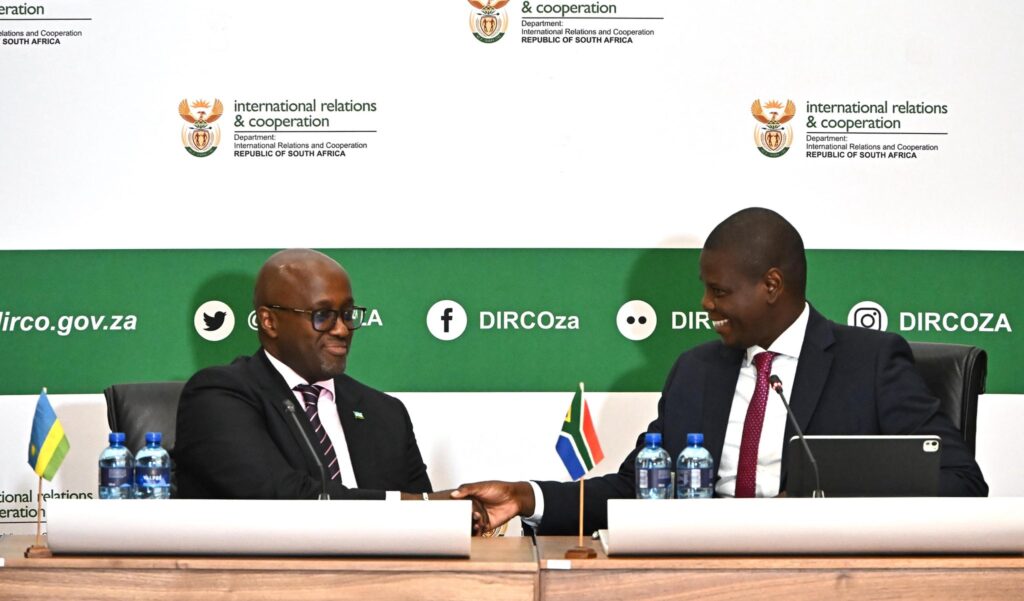
South Africa’s International Relations Minister Ronald Lamola and Rwanda’s Foreign Affairs Minister Olivier Nduhungirehe held bilateral talks in Pretoria on Wednesday 17 June 2026, calling on African countries to address the root causes of migration rather than blaming South Africa. Image: Supplied/DIRCO
Rwanda’s Foreign Affairs Minister Olivier Nduhungirehe has told African countries to stop reacting emotionally to the immigration situation in South Africa. The Rwanda South Africa migration statement came during a joint media briefing with Ronald Lamola in Pretoria on Wednesday 17 June 2026. Furthermore, Nduhungirehe urged African leaders not to react to social media reports about anti-immigration protests in South Africa. As a result, Rwanda has become one of the few African countries to publicly push back against the narrative directed at South Africa.
Rwanda South Africa Migration Statement: What Nduhungirehe Said
Nduhungirehe said African leaders must debate migration seriously. However, he urged them not to react emotionally to social media commentary about protests in South Africa. Furthermore, he called on African countries to address the root causes of migration. They should not simply criticise how individual countries respond to it.
Lamola agreed with that position. He said African countries need deeper economic development to reduce migration pressures. The debate should focus on why millions of Africans leave their home countries. Furthermore, economic hardship and instability are the real drivers of migration that need continental attention. As a result, both ministers framed migration as a shared African responsibility rather than a South African problem.
The Context Behind the Rwanda South Africa Migration Statement
Several African governments have taken public positions against South Africa since April 2026. Ghana chartered a government evacuation flight for 300 citizens. Nigeria approved five evacuation flights. Malawi repatriated thousands of nationals by road. Furthermore, Ghana petitioned the African Union over South Africa’s alleged xenophobia. Ghana has also confirmed it is considering legal action against South Africa.
Rwanda chose a different path. Nduhungirehe travelled to Pretoria to strengthen ties rather than add to the criticism. He used the platform to call on African governments to look inward. Furthermore, he questioned why so many citizens leave their countries in large numbers. As a result, Rwanda’s voice adds real diplomatic weight to South Africa’s side of the debate.
A Relationship Being Reset
The migration statement was not the only outcome of Wednesday’s meeting. South Africa and Rwanda also moved to repair a relationship strained for more than a decade. The two ministers confirmed that Rwanda will resume visa services for Rwandan nationals within twelve months. Furthermore, Rwandan citizens will enter South Africa without special passports. The Joint Commission on Cooperation will relaunch with a first meeting in Kigali in early 2027.
Rwanda also agreed to lift a ban on South African agricultural products in place since the 2017 listeriosis outbreak. Lamola called this an important step for bilateral and continental trade. Furthermore, Nduhungirehe thanked South Africa for supporting Rwanda’s post-genocide recovery through scholarships, health programmes and investment. As a result, Wednesday’s talks marked one of the most important moments in South Africa-Rwanda relations in years.
What South Africans Are Saying
Rwanda’s position has been welcomed widely. Commentary across social media reflects the view that Rwanda’s statement is a rare and honest acknowledgement of the full picture. Many have noted that South Africa is being asked to absorb millions of migrants from across the continent. However, it is simultaneously being criticised for the social consequences of that migration. Furthermore, many have pointed out that countries demanding dignity for their nationals in South Africa rarely address the conditions at home that push their citizens to leave. As a result, Rwanda’s voice has resonated strongly with South Africans following the debate closely.
Read our earlier coverage: Ramaphosa Addresses the Nation on Immigration.