

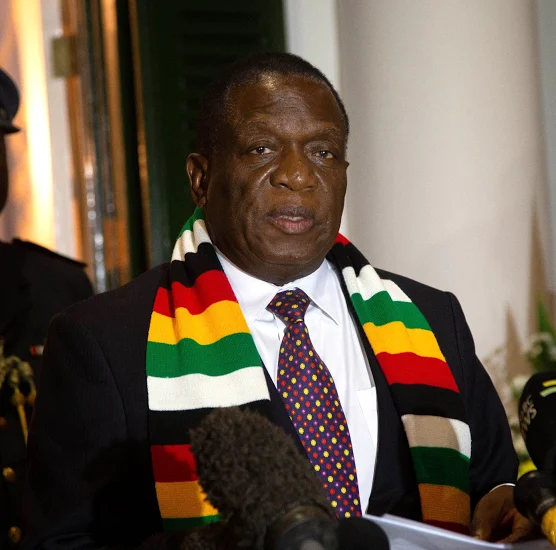
Zimbabwe’s President Emmerson Mnangagwa signed Constitutional Amendment No. 3 into law on Tuesday 7 July 2026, extending his presidency to 2030 and abolishing direct presidential elections. Tafadzwa Ufumeli/Getty Images
Zimbabwe’s President Emmerson Mnangagwa signed sweeping constitutional amendments into law on Tuesday 7 July 2026. The Mnangagwa Zimbabwe term extension law extends his presidency by two years to 2030 and abolishes direct presidential elections. Furthermore, the legislation extends presidential and parliamentary terms from five to seven years. As a result, Zimbabwe’s opposition has described the development as the death of democracy and vowed to challenge the law in court.
Mnangagwa Zimbabwe Term Extension: What the Law Does
The Constitution of Zimbabwe Amendment No. 3 Act 2026, known as CAB3, was published in a special Government Gazette on Tuesday after Mnangagwa signed it. Zimbabwe’s Parliament passed the bill in June by 216 votes out of 258. Both the National Assembly and the Senate approved the legislation before it reached the president’s desk.
The law makes four major changes. First, it extends Mnangagwa’s current term from 2028 to 2030. Second, it extends presidential and parliamentary terms from five to seven years. Third, it abolishes the direct popular election of Zimbabwe’s president. Future presidents will be elected by Members of Parliament sitting jointly as an electoral college. Fourth, it abolishes the National Peace and Reconciliation Commission. Its functions move to the Zimbabwe Human Rights Commission. Furthermore, the law creates a new position of Judge President of the Supreme Court. As a result, the constitutional framework of Zimbabwe has been fundamentally restructured in a single act of legislation.
Information Ministry official Nick Mangwana announced the president’s assent on X. “SIGNED, SEALED AND DELIVERED. IT IS NOW LAW,” Mangwana posted. As a result, Zimbabweans learned that elections scheduled for 2028 have been cancelled and replaced with an undetermined future date under a new system.
A Constitutional Coup Say Critics
Zimbabwe’s opposition reacted immediately and forcefully. Prominent opposition lawyer Tendai Biti described the new law as allowing the complete privatisation of power. “It pushes away power and legitimacy from millions of Zimbabweans to those that will be able to control the process and outcomes of any party primary election process,” Biti said on X. Furthermore, he argued that elections had been suspended to an unknown future date. As a result, critics including Biti have called the legislation a constitutional coup.
Democracy activist Lovemore Madhuku made a pointed observation. “Mnangagwa is in office by virtue of an election by the people yet uses that office to take away the very power that brought him into office,” he told AFP. Furthermore, the Law Society of Zimbabwe had argued that amendments affecting presidential term limits required approval in a referendum under Section 328(7) of the constitution. That legal argument was not resolved before Mnangagwa signed the bill. As a result, court challenges are expected.
Critics who opposed the changes publicly told AFP they faced torture, intimidation and abduction by suspected state agents. The opposition, weakened by years of repression and disputed elections, said the amendments would entrench ZANU-PF’s grip on power in a country the party has governed since independence in 1980.
Who Is Mnangagwa and How Did He Get Here
Emmerson Mnangagwa is 83 years old. He earned the nickname The Crocodile during his years as Robert Mugabe’s feared intelligence chief. He came to power in November 2017 in a military-backed coup that ousted Mugabe after 37 years in power. Mnangagwa was elected in 2018 and re-elected in a disputed election in 2023. Under Zimbabwe’s previous constitution, two five-year terms was the limit for a president.
Signs that Mnangagwa wanted to stay beyond 2028 emerged about two years ago. His supporters began chanting slogans at ZANU-PF rallies calling for more time. ZANU-PF adopted a formal resolution to amend the constitution last year. Cabinet backed the proposal in February 2026. Parliament passed it in June. Mnangagwa signed it into law on Tuesday. Furthermore, the legislation specifically states that the new term lengths apply to current office bearers. As a result, Mnangagwa benefits directly and immediately from the very constitutional changes he signed into law.
What the Mnangagwa Zimbabwe Term Extension Means for South Africa
The term extension carries direct implications for South Africa. Zimbabwe is one of South Africa’s most important neighbours and one of the largest sources of migrants. The immigration crisis that dominated South African politics in June 2026 involved hundreds of thousands of Zimbabwean nationals. Zimbabwe’s Foreign Affairs Minister Dr Amon Murwira said during the height of the crisis that there was no migration crisis. He told South Africa to address the root causes of migration rather than blaming foreign nationals.
Critics have long argued that the root cause of Zimbabwean migration to South Africa is ZANU-PF’s governance failures. Those failures include economic mismanagement, unemployment, currency collapse and political repression. Furthermore, a nationwide blackout plunged Zimbabwe into darkness this week as ZESA scrambled to restore power. As a result, the constitutional entrenchment of Mnangagwa’s presidency until 2030 is likely to sustain rather than reduce the migration pressures that have strained relations between the two countries.
What Happens Next
Zimbabwe’s opposition has vowed to challenge the law in court. Constitutional lawyers argue that the failure to hold a referendum provides strong grounds for a legal challenge. Furthermore, a war veteran has already filed an urgent High Court application to stop the amendment. Vice President Constantino Chiwenga, in what observers described as a cryptic public address, appeared to signal support for those defending the constitution. As a result, the political and legal fallout from Tuesday’s signing will continue for months.
Editors Note All information in this article is based on Reuters, AFP, IOL and AllAfrica reports published on 7 and 8 July 2026. The court challenges referenced in this article had not been formally filed or heard at the time of publication. Mzansi Today Live will update this article as further information becomes available.