
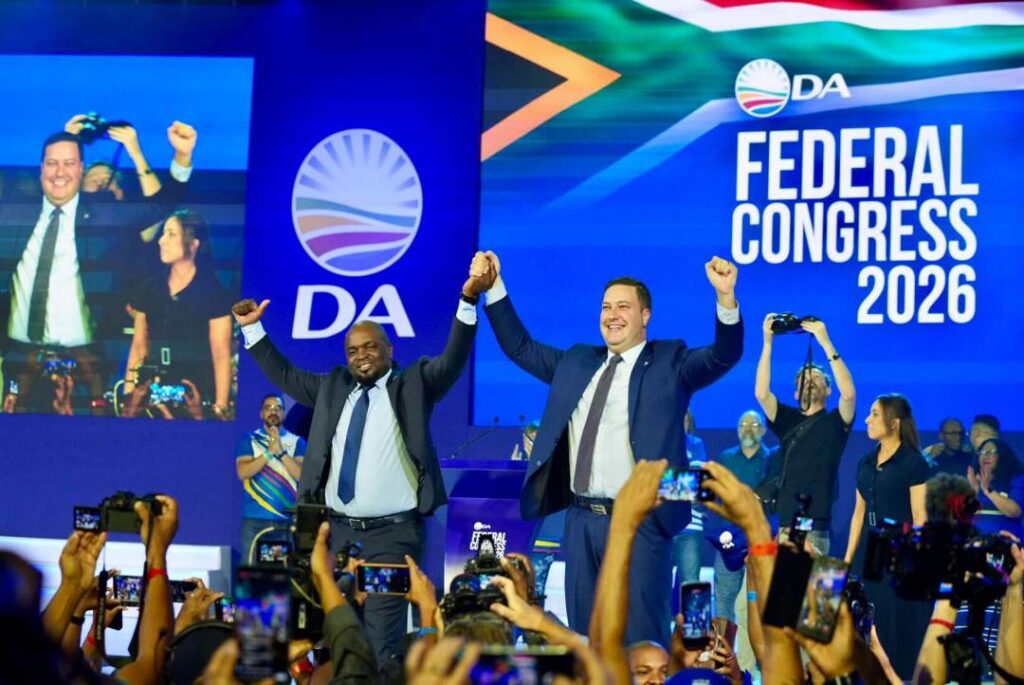
DA leader Geordin Hill-Lewis launched the party’s 2026 local government election manifesto at Mary Fitzgerald Square in Newtown, Johannesburg on Saturday 8 August 2026, promising to bring private sector companies into municipal service delivery and end cadre deployment. Image: Rosetta Msimango/News24
The Democratic Alliance launched its 2026 local government election manifesto at Mary Fitzgerald Square in Newtown, Johannesburg on Saturday 8 August 2026. The DA local government manifesto puts private sector delivery of basic municipal services at the centre of the party’s campaign. Furthermore, DA leader Geordin Hill-Lewis made three core guarantees to voters covering jobs, revenue protection and service delivery. As a result, the manifesto positions the DA as the party that will fix what Hill-Lewis called the normalisation of dysfunction in South African local government.
Hill-Lewis was blunt about the state of the country’s municipalities. Only 41 of South Africa’s 257 municipalities achieved a clean audit in the 2023 to 2024 financial year. Eighty-four percent could not account properly for public money. Municipalities burned more than R17 billion in fruitless and wasteful expenditure between 2021 and 2024. Furthermore, households and businesses owe municipalities R427.7 billion. About 88% of that is realistically uncollectible. As a result, Hill-Lewis said South Africans had been forced to accept broken infrastructure, water outages and failing roads as normal. “A working government should be ordinary,” he said.
The DA’s central proposal is to bring private sector companies into municipal service delivery through Section 78 of the Municipal Systems Act. The party wants to incentivise established private companies with solid records to invest in bulk water, electricity and waste removal infrastructure. DA-governed municipalities will bring in private operators where a council cannot cope. Furthermore, the party plans to buy electricity from independent power producers rather than relying solely on Eskom and City Power. As a result, the DA treats private sector involvement as the first solution rather than a last resort.
Hill-Lewis made three specific guarantees at the launch. First, municipal jobs under DA governance will go to qualified people rather than politically connected individuals. “Under the DA, municipal jobs will go to people who can actually do the work. They will not go to the politically connected,” he said. Second, money collected for water will only go toward water and electricity revenue will only go toward electricity. “Every rand collected for water will be protected for water. And every rand collected for electricity will be protected for electricity,” he said. Third, the DA commits to capable municipal police forces with the power to investigate crime. Furthermore, DA municipalities will publish the price of every contract they award. As a result, the DA aims to close the loopholes that allow corruption to hollow out municipal finances.
Not everyone welcomed the private sector plan. The South African Municipal Workers Union pushed back strongly. SAMWU argued the proposal amounts to privatisation of essential services and warned of devastating consequences for workers and communities. Political analyst Dr Harlan Cloete said the plan made practical sense. “At this stage, we need all hands on deck to be able to turn around many municipalities,” Cloete said. Furthermore, analyst André Duvenhage said private sector involvement already works in some South African towns. As a result, the private sector delivery debate is already shaping up as one of the defining arguments of the November 2026 election campaign.
The DA is targeting 60 of South Africa’s 257 municipalities in the 4 November 2026 elections. That is more than double the 27 it currently governs. Hill-Lewis described the manifesto as deliberately unglamorous. “Our promise is deliberately unglamorous: we will get your municipality working,” he wrote in a Business Day opinion piece. Big Zulu performed at the Newtown launch. Furthermore, the DA promised to find poor households that qualify for free water, electricity and refuse removal but are not yet on the relevant subsidy systems. As a result, the manifesto targets both the middle class frustrated by failing services and the poor who are not receiving what they are entitled to.
Editors Note All manifesto promises referenced in this article are those of the Democratic Alliance as presented at their 2026 local government election manifesto launch on 8 August 2026. They are electoral commitments and not yet policy. Mzansi Today Live will update this article as further information becomes available.