

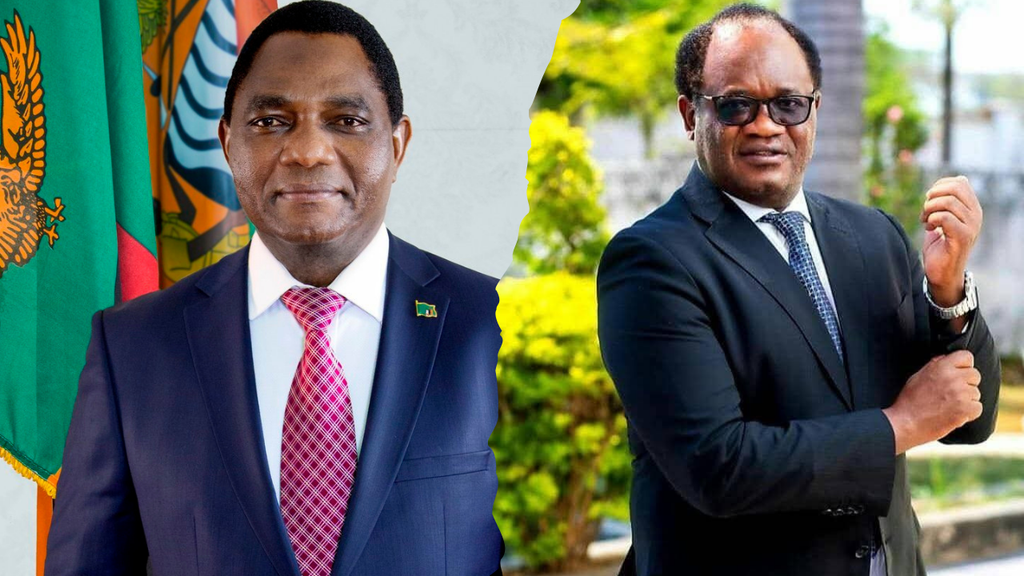
Armed police and military surrounded and sealed off court premises in Lusaka, Zambia on Monday 24 August 2026, the constitutional deadline for opposition candidate Brian Mundubile to file a formal petition challenging President Hakainde Hichilema’s August 13 election victory. Image: Reuters
Zambian authorities closed the country’s top courts on Monday 24 August 2026 and deployed armed military and police around court premises in Lusaka. The Zambia election shutdown fell on the constitutional deadline for opposition candidate Brian Mundubile to challenge President Hichilema’s August 13 election victory. Furthermore, lawyers who arrived to file the petition found courts wrapped in police tape and guarded by armed personnel. As a result, Mundubile’s window to challenge the election appears to have closed without a petition being filed.
The judiciary’s chief administrator issued an internal memo telling all court staff not to report for work. The memo cited vague security reasons. Armed police and military barricaded the High Court, Supreme Court and Constitutional Court in Lusaka. Yellow police tape surrounded the Constitutional Court perimeter. Furthermore, three armed men approached at least one lawyer’s vehicle and told him to leave. The Law Association of Zambia condemned the closure as without precedent. As a result, lawyers and civil society groups described the closure as a severe threat to the rule of law.
Hichilema won the August 13 election with approximately 60% of the vote. Mundubile came second with 38% and planned to challenge the result. Opposition representatives alleged the Electoral Commission halted vote counting when Mundubile was leading. They linked that to their broader complaints about the final results. Furthermore, Mundubile sought protection at United Nations premises in Lusaka after receiving threats. Armed men shot an opposition figure dead in the post-election period and authorities arrested others. As a result, Mundubile faced serious personal danger even before the courts shut him out.
Under Article 105 of the Zambian Constitution the opposition had seven days from the declaration of results to file a petition. A successful petition would have stayed Hichilema’s scheduled inauguration on 1 September 2026. Civil society lawyer Linda Kasonde explored a separate citizen-led petition but said she lacked sufficient evidence. Furthermore, legal experts noted that opposition lawyers may seek recourse through the COMESA Court of Justice under a bilateral agreement signed in June 2026. As a result, the domestic door may be closed but a regional legal avenue may still exist.
The Zambia election shutdown marks a dramatic fall from grace for Hichilema. He won power in 2021 after spending time in prison on politically motivated treason charges. His victory came as a rebuke of authoritarianism. He was himself a victim of political persecution under his predecessor Edgar Lungu. Furthermore, Hichilema spoke out against xenophobia in South Africa during the June 2026 immigration protests, positioning himself as a regional voice of moral authority. As a result, images of armed soldiers blocking Zambia’s courts on the final day for an election petition carry a particularly bitter irony.
Independent election observers raised concerns about the August 13 poll before the court closures made headlines. The European Union observation mission noted irregularities. Furthermore, the United States embassy in Lusaka expressed concern and called on Zambian authorities to uphold the constitution. As a result, what many once regarded as one of Africa’s more stable democracies now faces serious questions about its future under a president who once embodied the continent’s democratic hopes.
The Zambia election shutdown carries a particular significance for South Africa. Hichilema was one of the African leaders who spoke out most loudly against xenophobia in South Africa during the June 2026 immigration protests. He positioned himself as a champion of human rights and the rule of law on the continental stage. Furthermore, those same values he preached to South Africa appear absent in his own country’s post-election conduct. As a result, South Africans watching events in Lusaka are asking a straightforward question. How does a president lecture a neighbouring country about the rights of foreign nationals while deploying soldiers to block his own citizens from accessing their constitutional courts?
Editors Note All information is based on reporting by Reuters, Bloomberg, BBC, Africanews and the Lusaka Times published on 24 and 25 August 2026. President Hichilema denied allegations of electoral fraud. The Zambian government did not officially comment on the court closures beyond citing security reasons. Mzansi Today Live will update this article as further information becomes available.