

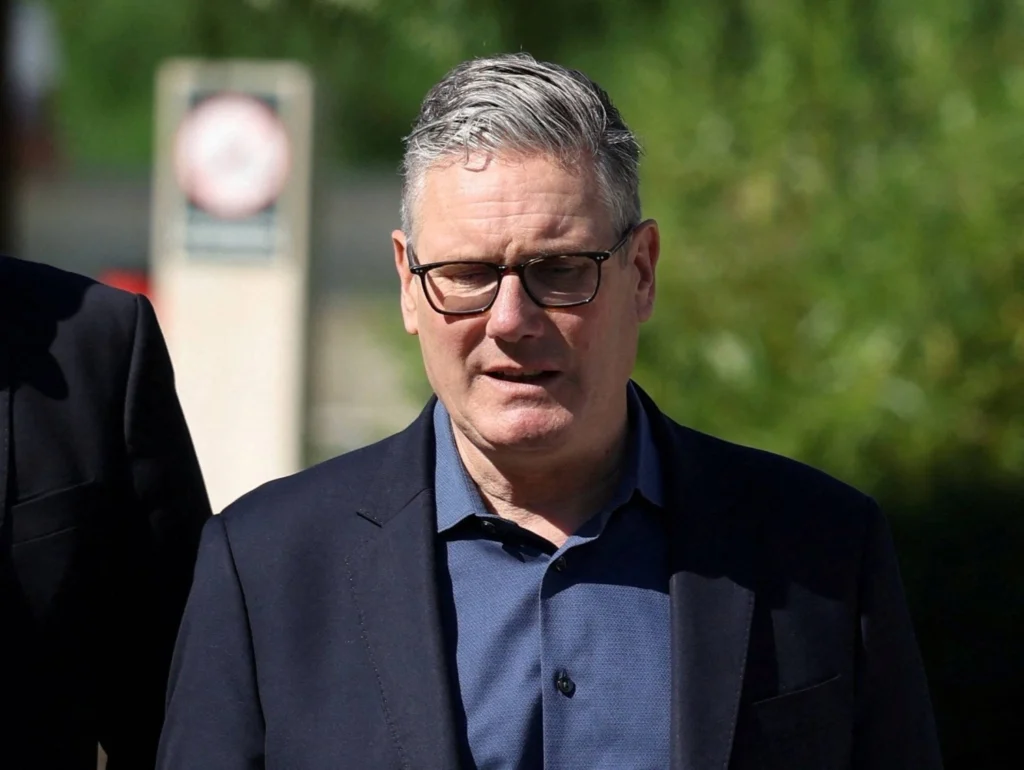
British Prime Minister Keir Starmer announces his resignation outside 10 Downing Street in London on Monday 22 June 2026 after less than two years in office. Image: Reuters
British Prime Minister Keir Starmer has resigned as leader of the Labour Party and as Prime Minister of the United Kingdom. The Keir Starmer resignation was announced outside 10 Downing Street on Monday 22 June 2026. Furthermore, Starmer said he will remain as caretaker Prime Minister until Labour chooses a new leader. As a result, the UK is set to have its seventh Prime Minister in a decade.
Keir Starmer Resignation: What He Said Outside Downing Street
Starmer delivered a brief and emotional statement outside Number 10 on Monday morning. He confirmed he had spoken to King Charles III before making the announcement. “The question my party is asking now is whether I am best placed to lead us into the next general election,” Starmer said. “I have heard the answer. I accept that answer with good grace. I will resign as leader of the Labour Party.”
His voice broke as he paid tribute to his wife Victoria and their two children. He framed his exit as an act of service rather than defeat. “Every decision I have taken has been about putting the country I love first,” he said. Furthermore, Labour lawmakers applauded him from the sidelines of Downing Street as he spoke. As a result, his departure was dignified but clearly emotional.
What Triggered the Keir Starmer Resignation
Andy Burnham’s victory in the Makerfield by-election on Friday 19 June 2026 was the immediate trigger. Burnham, the popular former Mayor of Greater Manchester, entered Parliament specifically to challenge Starmer for the Labour leadership. His arrival made a formal contest hard to avoid. Furthermore, more than 20 ministers quit during Starmer’s tenure. An Ipsos poll on Friday showed 52% of the British public wanted Starmer to go. As a result, his position became impossible to defend.
The broader collapse began months earlier. Labour lost more than 1,000 council seats in local elections in May 2026. Furthermore, his decision to appoint Peter Mandelson as UK Ambassador to the United States drew fierce criticism. Former Health Secretary Wes Streeting resigned in May, saying Starmer would not lead Labour into the next election. As a result, the writing had been on the wall for weeks.
Andy Burnham Steps Forward After the Resignation
Burnham confirmed on Monday that he will seek to replace Starmer as Labour leader and Prime Minister. He is the clear favourite. Wes Streeting endorsed Burnham on Monday morning. Furthermore, Burnham took his seat in Parliament on Monday, a necessary step since Prime Ministers must be sitting MPs.
Nominations open on 9 July 2026 and close when Parliament breaks for summer recess on 16 July. If Burnham runs unopposed he could be in office shortly after that. However, if a contest develops, a new leader will be chosen by 1 September 2026. As a result, the UK could have a new Prime Minister within weeks.
Seven Prime Ministers in a Decade
Starmer is the sixth sitting Prime Minister in a decade to announce a premature departure from Downing Street. His successor will be the seventh UK leader in ten years. David Cameron quit after losing the 2016 Brexit referendum. Theresa May spent three years managing Brexit before stepping down. Boris Johnson left in July 2022. Liz Truss lasted just 44 days. Rishi Sunak lost the 2024 election to Starmer in a Labour landslide. Now Starmer himself is gone inside two years.
The Keir Starmer resignation comes almost exactly ten years after the UK voted to leave the European Union. Furthermore, Trump weighed in before the official announcement, posting that Starmer had failed badly on immigration and energy. As a result, even his departure became entangled in the transatlantic turbulence that marked much of his time in office.
What This Means for South Africa
The UK remains South Africa’s third largest trading partner and a key source of foreign investment. A leadership change in Britain creates short-term uncertainty in that relationship. Furthermore, the UK-South Africa Just Energy Transition Partnership is an ongoing commitment that a new leader must honour. As a result, South African businesses, investors and government officials will be watching the transition closely in the weeks ahead.