

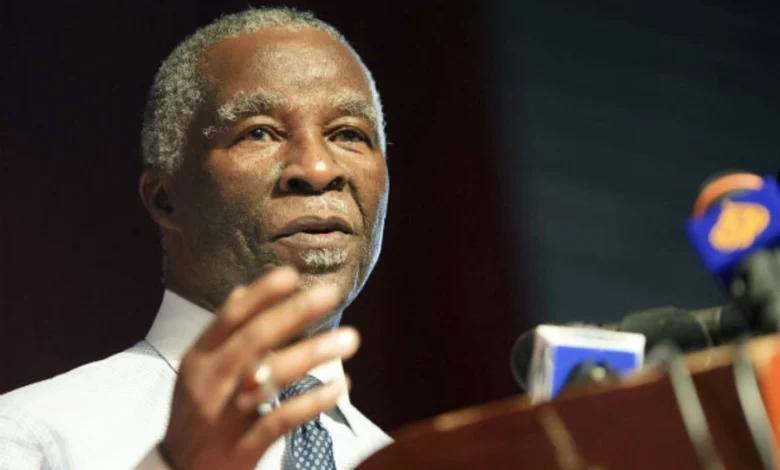
Former President Thabo Mbeki has condemned rising anti-migrant sentiment in South Africa during a public discussion on migration and African integration. Image: Supplied/GCIS
Former President Thabo Mbeki has spoken out against rising anti-migrant sentiment in South Africa, warning that hostility toward African migrants will not resolve the country’s unemployment and economic challenges. South Africans say they are tired of politicians who are disconnected from their daily reality.
Former President Thabo Mbeki has waded into South Africa’s increasingly heated immigration debate, condemning what he described as rising anti-migrant sentiment and cautioning against holding African migrants responsible for the country’s socioeconomic difficulties. Mbeki made his remarks during a public discussion focused on migration and African integration.
The Liberation Struggle Argument
Central to Mbeki’s argument was the historical relationship between South Africa and the rest of the African continent. He argued that a significant number of South Africans do not fully appreciate that the continent rallied behind South Africa’s liberation movement during the apartheid era, viewing the struggle not as a South African matter alone but as a cause that belonged to all of Africa.
Mbeki said this shared history helps explain why many Africans feel a natural connection to South Africa and continue to move to the country. He argued that this context should inform how South Africans relate to African migrants today rather than treating their presence as a problem to be solved through hostility.
A Regression in African Solidarity
Beyond the immediate debate, Mbeki expressed concern about what he sees as a broader deterioration in the spirit of African unity and integration that took hold in the years following South Africa’s democratic transition in 1994. He described the current climate as a step backward from the values that defined the post-apartheid era.
“There is a regression that is taking place,” Mbeki said. “That sense of African integration that we had 25 years ago, I think has receded.”
He was firm in his view that South Africa’s unemployment crisis and other economic pressures cannot be addressed by directing frustration at foreign nationals, arguing that the root causes of poverty and joblessness lie elsewhere and require different solutions.
South Africans Push Back
Mbeki’s remarks have drawn a sharp response from South Africans online, with commentary across social media reflecting a deep frustration with what many describe as a political class that is increasingly removed from the realities faced by ordinary citizens.
The sentiment expressed widely is that appeals to liberation struggle solidarity, however historically valid, do not speak to the day-to-day experience of South Africans who struggle to find employment in their own country. Many have pointed out that the same generation of political leaders who invoke African solidarity also presided over three decades of government during which the structural economic inequalities driving the current tensions were never meaningfully addressed.
South Africans online have also drawn a firm distinction between what they say the debate is actually about and how it is being characterised by voices like Mbeki’s. The protests that took place in Johannesburg and Pretoria in recent weeks were, in the view of those who participated, calls for the enforcement of existing South African immigration and labour laws rather than expressions of hostility toward Africans as a group. The characterisation of those calls as anti-African sentiment is one that many South Africans reject directly.
The overarching response to Mbeki’s comments can be summarised simply. South Africans say they are done being lectured about solidarity by politicians who live behind high walls, far from the communities most affected by unemployment, illegal employment practices and the pressures on public services that ordinary people navigate every day.
The Timing
Mbeki’s remarks come against the backdrop of one of the most intense periods of national debate about immigration that South Africa has experienced in years. Ghana recently chartered a government-funded flight to evacuate 300 of its citizens from South Africa citing safety concerns. One person boarded that flight. South Africa’s unemployment rate currently stands at 32.7 percent. Youth unemployment exceeds 45 percent.
For many South Africans, those numbers are the conversation. And they say no amount of historical argument changes what those numbers mean for people trying to survive in the present.
Editors Note The views expressed by South Africans referenced in this article are those of members of the public expressed online and on the ground and do not represent the editorial position of Mzansi Today Live. Mzansi Today Live presents both perspectives in this article in the interest of balanced and complete reporting.