
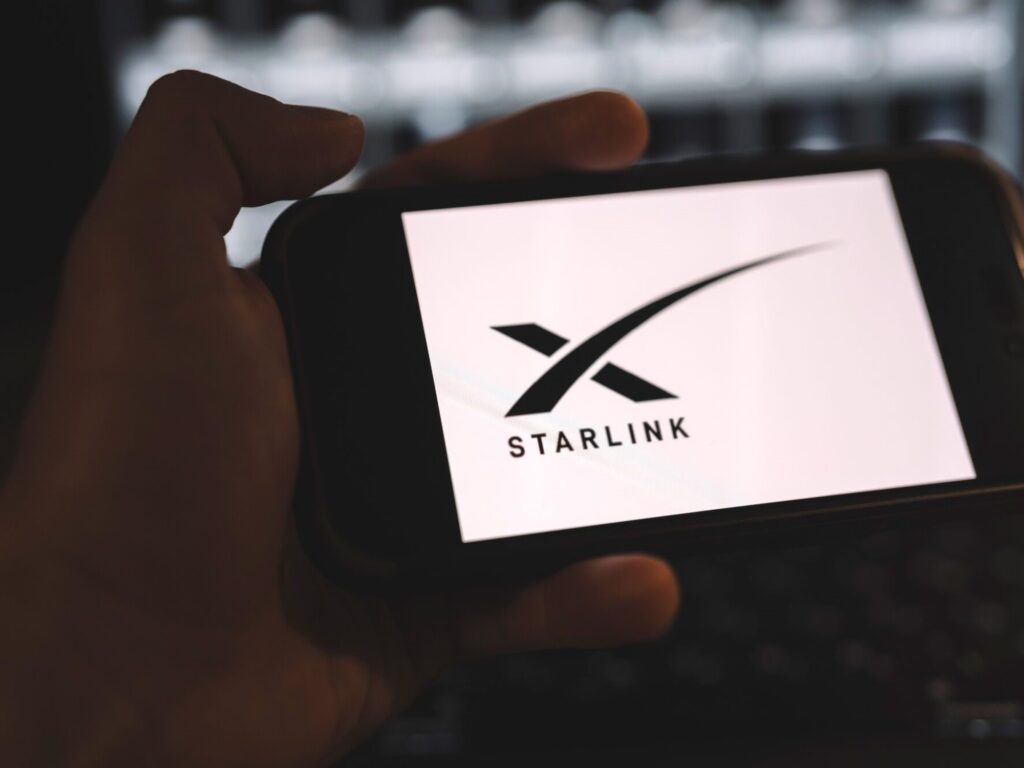
Namibia’s Communications Regulatory Authority dismissed all 624 appeals against its decision to block Starlink from operating in the country on Monday 22 June 2026, locking Elon Musk’s satellite internet service out of another African market. Image: Andrew Kravchenko/Bloomberg
Namibia has rejected every appeal against its decision to block Elon Musk’s Starlink from operating in the country. The Namibia Starlink rejection was confirmed by the Communications Regulatory Authority of Namibia on Monday 22 June 2026. Furthermore, CRAN dismissed all 624 reconsideration requests it received after blocking Starlink’s licence applications in March. As a result, Starlink remains locked out of the Namibian market with no immediate path to entry.
Namibia Starlink Rejection: What CRAN Decided
CRAN CEO Emilia Nghikembua confirmed the outcome at a media briefing on Monday. The regulator received 624 requests for reconsideration after its March 2026 decision to reject Starlink’s licence applications. Furthermore, 622 of those requests failed to meet the procedural and legal requirements for review. Only two qualified for formal consideration. However, neither introduced new facts or identified material errors in the original decision. As a result, all 624 appeals were dismissed.
Starlink Internet Services Namibia filed its own reconsideration request on 8 June 2026. CRAN dismissed it immediately. The regulator said the application arrived outside the statutory 30-day appeal window, which closed on 22 April 2026. “The law requires that the application must be submitted 30 days from the date of the decision. The 30 days to submit the application lapsed on April 22, 2026,” Nghikembua said. Furthermore, a public petition signed by 5,500 Namibian citizens supporting Starlink’s entry was also rejected for the same reason. It arrived on 17 June 2026, well after the statutory deadline.
Why Namibia Blocked Starlink in the First Place
CRAN first rejected Starlink’s applications in March 2026. The reason was straightforward. Starlink failed to comply with Section 46 of Namibia’s Communications Act, which requires telecommunications operators to have majority local ownership. Starlink holds the position that it will not cede equity in any local subsidiary. As a result, the company cannot meet the ownership threshold that Namibia’s law requires.
Namibia gave Starlink 90 days to appeal after the March rejection. The company filed its appeal late. Therefore, the regulator was legally unable to consider it on its merits regardless of whether the arguments inside it were compelling.
The South Africa Connection
The Namibia Starlink rejection closely mirrors the standoff playing out in South Africa. South African law requires telecommunications licence holders to be at least 30% owned by historically disadvantaged groups. Starlink has consistently refused to meet that requirement. Musk, who was born in Pretoria, has claimed on X that he cannot get a licence in his own birth country because he is not Black, a remark that drew sharp responses from the South African government and the public.
Communications Minister Solly Malatsi attempted to create a workaround in December 2025. He gazetted a policy direction that would allow ICASA to recognise equity-equivalent investment programmes, letting multinationals invest in skills, enterprises or infrastructure instead of selling shares. However, in May 2026, ICASA told Malatsi it could not fully implement the direction without amending the Electronic Communications Act. That process now faces a parliamentary timeline that could take months or years. As a result, a legal and regulated Starlink launch in South Africa is widely considered unlikely before 2027.
A Growing African Divide on Starlink
Namibia and South Africa are holding firm against Starlink at a time when many other African countries have moved in the opposite direction. Starlink currently operates in Lesotho, Zimbabwe, Zambia, Eswatini, Malawi, Mozambique, Madagascar, Botswana, Ghana, Nigeria, Rwanda, Kenya and more than a dozen other African nations. Furthermore, Starlink is set to launch in Côte d’Ivoire in July 2026 after receiving a 12-month provisional licence.
Many of those countries relaxed their local ownership requirements specifically to allow Starlink in, driven by demand for fast and reliable internet in communities far from urban centres. Namibia has chosen not to follow that path. The regulator made its position clear. “While Low Earth Orbit satellite technologies can support national connectivity goals, all operators must comply with Namibia’s legal framework,” CRAN said. As a result, Namibia is emerging as one of the most significant test cases on the continent for how African governments balance foreign investment against economic sovereignty.
What Happens Next
Starlink did not immediately respond to requests for comment following Monday’s dismissal. The company has no immediate path to a licence in Namibia unless it changes its ownership structure or Namibia changes its law. Neither appears likely in the short term. Furthermore, with South Africa also unlikely to resolve its Starlink impasse before 2027, the world’s most valuable satellite internet company finds itself locked out of two of southern Africa’s most significant markets simultaneously.
Editors Note All information in this article is based on CRAN CEO Emilia Nghikembua’s media briefing on 22 June 2026 and reports published by Bloomberg, Business Tech, Connecting Africa and TechPoint Africa on the same date.