
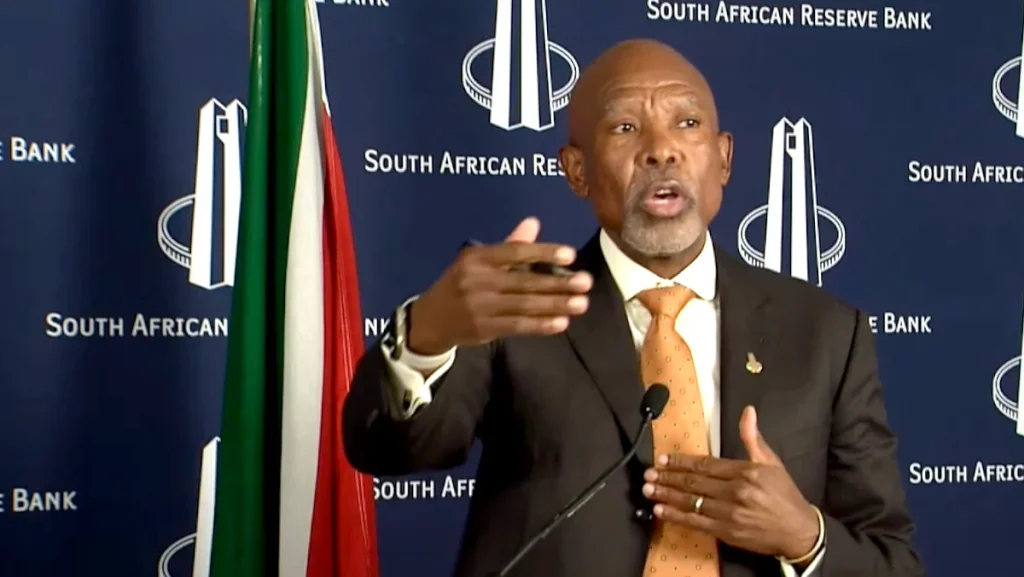
South African Reserve Bank Governor Lesetja Kganyago announcing the Monetary Policy Committee decision on 23 September 2026. Image: Supplied
The Reserve Bank hikes interest rates by 25 basis points, effective 23 September 2026. The repo rate now stands at 7.0% and the prime lending rate moves to 10.75%. Four of six Monetary Policy Committee members voted in favour of the increase. Two members voted to hold rates unchanged. The decision reflects growing concern about inflation driven by rising global fuel prices.
SARB Governor Lesetja Kganyago cited surging fuel prices and a projected headline inflation rate of 5% as the main drivers behind the decision. Iran’s closure of the Strait of Hormuz earlier this year disrupted global oil supplies, causing South African fuel prices to surge by 11% in April alone. Headline inflation consequently rose to 4.0%, prompting the MPC to act. “We face a painful combination of higher global uncertainty and reduced disposable income. This will hit both investment and household consumption, which have been our main growth drivers,” Kganyago said.
How the Reserve Bank Interest Rate Hike Affects Your Pocket
South African homeowners feel the impact immediately. On an R800 000 home loan over 20 years, monthly repayments rise by R135. Over the life of the loan, that adds up to R32 350 in additional interest. Homeowners with a R1.5 million bond pay R253 more each month, amounting to R60 657 in extra interest over 20 years. Those with a R3 million bond face a R505 monthly increase and pay R101 094 more in total interest.
Furthermore, vehicle finance also becomes more expensive. A R250 000 car loan over six years costs R32 more per month. A R500 000 vehicle loan increases by R64 per month. Over the full loan term, the additional interest burden reaches R2 292 and R4 583 respectively. These figures assume no deposit and standard terms.
Samuel Seeff of Seeff Property Group warned the hike will inflict real financial pain on households and businesses. He argued that the inflationary spike stems from temporary factors like global oil prices rather than domestic demand pressures, suggesting the hike may be premature. In addition, FNB took a different view, emphasising that managing inflation remains critical for protecting purchasing power and supporting long-term economic confidence.
Further Rate Hikes Cannot Be Ruled Out
The SARB signalled that further pressure on interest rates remains possible. Under adverse conditions, the bank projects inflation could reach between 5% and 6%, potentially requiring up to three additional hikes beyond the current baseline projection. Moreover, Bank of America analysts have forecast two rate hikes for South Africa in 2026, suggesting Tuesday’s increase may not be the last.
The timing of the hike adds to an already difficult financial environment for South African consumers. Fuel prices remain elevated, food inflation continues to squeeze household budgets, and economic growth projections remain modest. Combined with higher borrowing costs, disposable income faces pressure from multiple directions simultaneously.
The next Monetary Policy Committee meeting will determine whether the SARB holds, cuts, or raises rates further. For now, consumers and businesses must absorb the latest increase as the central bank attempts to anchor inflation expectations in a volatile global environment.