

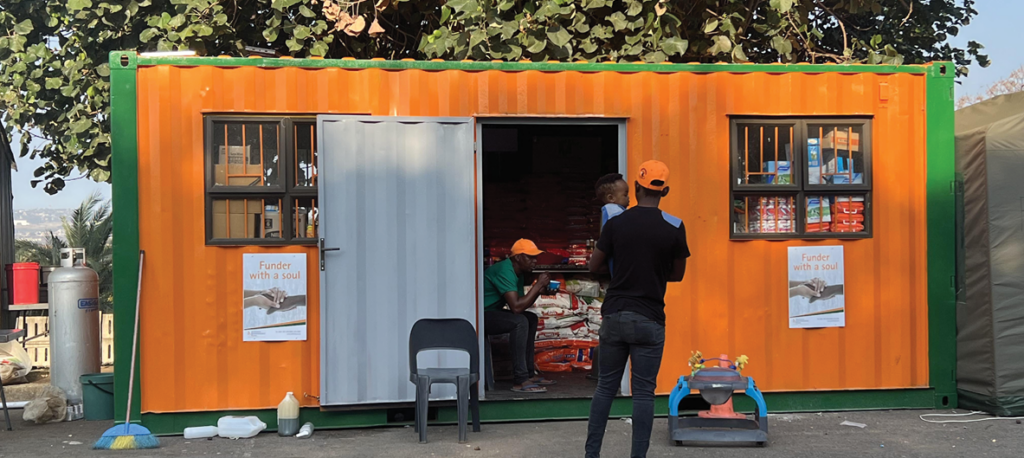
The South African government’s R500 million Spaza Shop Support Fund is open for applications, offering township and rural spaza shop owners up to R300,000 in grants and low-interest loans. Image: Vuk’uzenzele
The South African government’s R500 million Spaza Shop Support Fund is open for applications and has already processed thousands of submissions. But questions are being raised about the fund’s definition of youth as anyone aged 18 to 35, with many South Africans asking why a 36-year-old spaza shop owner does not qualify for priority consideration.
The South African government’s R500 million Spaza Shop Support Fund is open and processing applications. The fund, launched by the Department of Small Business Development in partnership with the Department of Trade, Industry and Competition, offers township and rural spaza shop owners funding of up to R300,000 per enterprise. It is closed to foreign nationals by design. But as applications pour in, questions about the fund’s eligibility criteria — particularly the age limit defining youth — are gaining traction online.
What the Fund Offers
The Spaza Shop Support Fund provides a combination of grants and low-interest loans to qualifying South African-owned spaza shops in townships and rural areas. The support package includes a R40,000 stock grant delivered through supply partners, up to R50,000 for infrastructure including shelving, security and equipment upgrades, and up to R100,000 in training covering point-of-sale systems, food safety and digital skills.
For youth applicants the fund offers up to R250,000 in blended funding structured as 50 percent grant and 50 percent interest-free loan, plus an additional R100,000 for training and compliance support. Applications are administered by the National Empowerment Fund and the Small Enterprise Development Finance Agency. South Africans can apply at spazashopfund.co.za.
Who Qualifies
To qualify for the fund, applicants must be South African citizens or naturalised citizens. The spaza shop must operate in a township or rural area and be registered with the local municipality. Registration with SARS is required or must be completed within a six-month transitional period. The owner must actively manage the shop. The fund is explicitly closed to foreign nationals.
Priority consideration is given to youth aged 18 to 35, women and people with disabilities. Minister of Small Business Development Stella Ndabeni-Abrahams confirmed in May 2026 that of the applications being processed, 4,426 are for black-owned businesses, 2,207 are female-owned, 1,267 are youth-owned between the ages of 18 and 35, and 118 are owned by people with disabilities. A total of R44.572 million has been paid out, with a further R362.7 million in applications in the pipeline.
Why Is the Youth Age Limit 35?
The question drawing the most attention online is why the fund defines youth as anyone aged 18 to 35. For many South Africans, the cut-off feels arbitrary and exclusionary. A 36-year-old spaza shop owner who has been struggling to keep their business alive amid competition from foreign-owned shops does not qualify for youth priority consideration. A 40-year-old who lost their job during the Covid-19 pandemic and started a spaza shop as a means of survival is also excluded from the youth priority bracket.
Commentary across social media reflects the view that the 35-year-old cut-off reflects a definition of youth that is more aligned with government policy frameworks and international development conventions than with the lived reality of South African township economies, where many people enter entrepreneurship later in life due to structural barriers including unemployment, lack of capital and the absence of business development support during their earlier years.
The South African government’s definition of youth as individuals aged 14 to 35 is consistent across multiple policy frameworks including the National Youth Policy and the National Youth Development Agency Act. The 35-year-old upper limit is also used by the Youth Entrepreneurship Fund, the NYDA Grant and several Industrial Development Corporation programmes. Proponents of the limit argue that it concentrates scarce resources on the demographic most likely to build businesses that will generate long-term employment and economic activity.
Critics argue that in a country where unemployment stands at 32.7 percent and where millions of South Africans did not have access to economic opportunity in their twenties and early thirties, the 35-year limit excludes a significant portion of the people the fund is most needed by.
The Broader Reaction
Beyond the age limit debate, reaction to the fund has been broadly positive among township entrepreneurs who have long called for exactly this kind of targeted government support. Gracious Sholwane, a spaza shop owner from Kabokweni in Mpumalanga, described the initiative as one that would uplift many small businesses including her own.
However, South Africans have also raised questions about the pace of disbursement. Of the R500 million allocated, only R44.572 million had been paid out at the time of Minister Ndabeni-Abrahams’ update in May 2026, with the majority of approved applications still in the pipeline. South Africans have noted that announcements of funding and the actual disbursement of that funding have historically been very different things in South Africa, and that township entrepreneurs who need support now cannot wait indefinitely for a bureaucratic pipeline to move.
Others have pointed out that the fund, while welcome, does not address the underlying structural challenge of foreign-owned businesses operating in township retail. The MK Party’s Private Member’s Bill seeking to reserve spaza shop ownership exclusively for South African citizens remains before Parliament. South Africans argue that funding existing local shops is necessary but insufficient if foreign-owned shops continue to operate in the same space without equivalent restrictions.
How to Apply
South African spaza shop owners who believe they qualify are encouraged to visit spazashopfund.co.za to begin the application process. Applications can also be submitted through the National Empowerment Fund at nefcorp.co.za and through SEDFA at sedfa.co.za.
Editors Note All funding figures and application statistics referenced in this article are based on Minister Ndabeni-Abrahams’ parliamentary briefing and publicly available government communications as at May 2026. Mzansi Today Live will update this article as further information becomes available.