

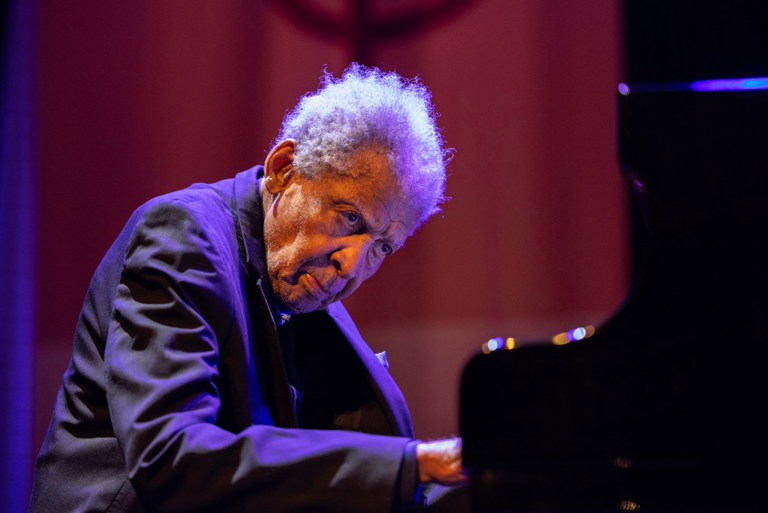
South African jazz legend Abdullah Ibrahim, born Adolph Johannes Brand in Cape Town in 1934, has died at the age of 91 in Germany. He performed at Nelson Mandela’s 1994 inauguration and created Mannenberg, one of the most powerful pieces of music in South African history. Image: Supplied
South African jazz legend Abdullah Ibrahim has died at 91. The Abdullah Ibrahim death was confirmed by his family on Monday 15 June 2026. Furthermore, his partner Dr Marina Umari confirmed he died peacefully in Germany after a short illness. As a result, South Africa has lost one of its greatest cultural voices and the jazz world has lost one of its most important figures of the past century.
Abdullah Ibrahim Death: The Family Statement
The family released a formal statement on Monday. “It is with profound sadness that the family of legendary South African pianist, composer and global jazz icon Abdullah Ibrahim announces his passing at the age of 91,” the statement read. Dr Umari said Ibrahim died with South Africa and its people in his heart. “His love for his country never wavered, no matter where in the world he found himself,” she said.
Furthermore, the family confirmed Ibrahim will be laid to rest in the Bavarian region of Germany. His final South African performance took place at the Cape Town International Jazz Festival in March 2026. As a result, fans who attended got to witness a master at work one last time.
A Life That Changed Music Forever
Abdullah Ibrahim was born Adolph Johannes Brand in Kensington, Cape Town on 9 October 1934. He grew up in a city full of musical diversity. The communities of his childhood mixed African song, church gospel and American jazz. His mother played piano in church. Her style stayed with him as he learned marabi, mbaqanga and jazz from an early age.
Ibrahim started piano lessons at seven. He made his professional debut at fifteen. Furthermore, the world first knew him as Dollar Brand. His conversion to Islam in 1968 led him to take the name Abdullah Ibrahim. As a result, a new name marked the start of an even more remarkable chapter in one of the longest careers in South African music history.
Mannenberg: The Song That Became a Cry for Freedom
One recording stands above all others in Ibrahim’s career. In June 1974, he visited South Africa from New York and entered a studio with saxophonists Basil Coetzee and Robbie Jansen. What followed was one take of pure improvisation. The result was Mannenberg, named for the Cape Flats township where families from District Six had been forcibly resettled under apartheid.
Mannenberg became more than a jazz piece. It became the unofficial anthem of South Africa’s liberation movement. Furthermore, it captured the pain and quiet defiance of a community the apartheid state had uprooted and discarded. As a result, one afternoon in a studio produced one of the most powerful pieces of music South Africa has ever known.
Exile, Return and a Nation’s Gratitude
Ibrahim spent much of the apartheid era in exile in New York. However, he returned to South Africa through the 1970s when he could. As apartheid ended in the early 1990s, Ibrahim came home to a country eager to embrace him. He performed at Nelson Mandela’s inauguration in 1994. Furthermore, Mandela called him South Africa’s Mozart. As a result, few tributes in South African cultural history have carried more weight.
In 1999, Ibrahim founded the M7 Academy for young South African musicians. He also launched the Cape Town Jazz Foundation to preserve Cape Jazz traditions. Furthermore, he kept returning to South African stages for decades. As a result, audiences understood they were watching living history every time he played.
Global Recognition and a Timeless Body of Work
Ibrahim performed on the world’s most respected stages. He worked alongside Duke Ellington, who helped introduce him to global audiences in the 1960s. His recordings span more than seven decades. They include classics like Chisa, The Wedding and Whoza Mtwana. Furthermore, governments and cultural institutions across the world recognised his contribution through honorary doctorates and lifetime achievement awards.
His music mixed jazz, Cape traditions, gospel, African rhythms and Islamic spiritual sounds into something entirely his own. No other South African musician crossed so many stylistic boundaries while staying so deeply connected to one place and one people. As a result, Abdullah Ibrahim leaves a musical legacy South Africa will draw from for generations.
South Africa Mourns Abdullah Ibrahim
News of Ibrahim’s death spread quickly on Monday afternoon. Tributes arrived from musicians, politicians and ordinary South Africans who grew up with his music. Furthermore, the global jazz community shared its grief as word reached audiences across Europe, North America and Africa. As a result, the loss of Abdullah Ibrahim is felt far beyond South Africa’s borders.
He was 91 years old. He died in Germany. He died with South Africa in his heart.
Editors Note The death of Abdullah Ibrahim was confirmed by his family to IOL on Monday 15 June 2026. He passed away peacefully in Germany after a short illness. Mzansi Today Live extends its deepest condolences to his family, friends and the global community of musicians and fans who loved his work.