

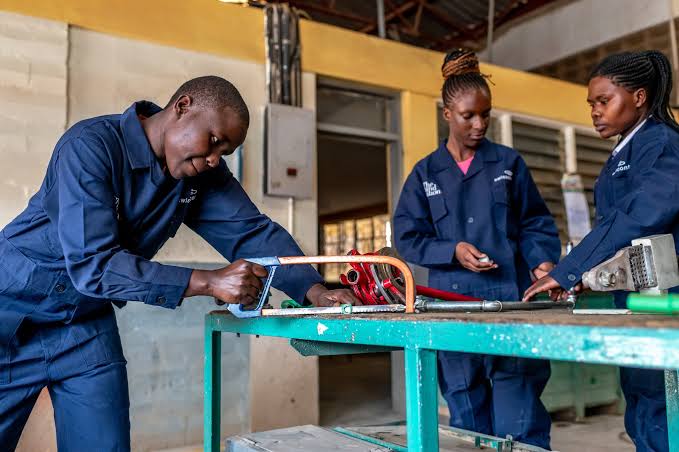
South Africa faces a severe artisan shortage decades after vocational subjects were removed from ordinary schools. image: supplied
South Africa’s skills shortage is not a mystery. It is a consequence. For years, government officials, business leaders and economists have pointed fingers at young South Africans, framing the unemployment crisis as a problem of individual inadequacy. However, a growing body of evidence tells a different story — one that leads directly back to decisions made inside government itself. The South Africa skills crisis did not emerge from nowhere. In large part, it was built into the education system by design.
The South Africa Skills Crisis and What Government Removed
Decades ago, South African schools offered practical subjects as a standard part of the curriculum. Learners studied woodwork, metalwork, bricklaying, home economics, technical drawing and other hands-on trades inside classrooms and workshops. These were not fringe subjects. They were pathways. They prepared young people for the building sector, the manufacturing industry, the trades and the broader working economy.
Then came the post-apartheid curriculum reforms. Curriculum 2005, introduced in the late 1990s, shifted the education model toward outcomes-based learning with a strong academic orientation. In the process, many of the vocational and technical subjects that had existed in ordinary schools were quietly phased out or deprioritised. The assumption, broadly, was that academic achievement was the primary measure of educational success. The trades were left behind.
The consequences have been severe. According to research, South Africa currently produces less than 45% of the number of artisans that the economy requires and less than half the number it produced a quarter of a century ago. That is not a statistic about lazy youth. That is a statistic about a system that stopped training them.
What the Data Says About the South Africa Skills Crisis
The artisan shortage affects every layer of South African infrastructure. Municipalities battle to render proper services because artisans are critical for the operation and maintenance of infrastructure and equipment. The private sector faces the same pressure. Manufacturing, mining and heavy industry have all reported acute shortages of skilled tradespeople. Yet government has continued to speak about the skills gap as though it fell from the sky.
The problem is structural. South Africa’s schooling system lacks sufficient subject choice differentiation. Learners are not able to choose subject packages that constitute specific vocational fields such as technology, hospitality and tourism, information technology and agricultural fields. This is not an accident of circumstance. It is the direct result of curriculum choices made at policy level.
Furthermore, South Africa’s 50 public technical and vocational education and training colleges are, in the main, struggling institutions. They face low throughput rates, under-qualified lecturers and uneven relationships with employers. The TVET college system was supposed to fill the gap left by schools. Instead, it has been battered by decades of under-investment, constant restructuring and unclear mandates. Over 30 years of democracy, government has renamed these colleges, restructured them and given them new governance models, new qualification types and new funding arrangements. It has not worked.
The Government Is Now Trying to Fix What It Broke
To be fair, government has acknowledged the problem. The Department of Basic Education has introduced a three-stream model designed to bring vocational and occupational learning back into the schooling system alongside the existing academic stream. Implementation has begun in 74 Schools of Skill across the country, with pilot schools in Gauteng, KwaZulu-Natal, North West and the Western Cape. Subjects such as bricklaying, plumbing, boilermaking and carpentry are being reintroduced in selected schools.
However, the scale remains deeply inadequate. Of more than 20 000 public schools in South Africa, only 105 were approved to roll out vocationally oriented and occupational curricula. That represents a fraction of a fraction. Moreover, implementation of the three-stream model is moving slowly. Serious questions remain about whether schools have the infrastructure, teachers and resources to sustain what is being piloted.
In addition, teacher training for vocational subjects has not kept pace with the new direction. The Department of Basic Education still needs to work with higher education institutions to build sufficient capacity for implementation. That process is ongoing. Meanwhile, entire generations of young South Africans have passed through a system that offered them an academic curriculum they could not use and no practical alternative.
Complexity and Context
It would be reductive to place every failure at government’s door alone. Researchers have noted that poverty plays a significant and independent role. Poverty constrains teaching. It affects who becomes a teacher, how teachers are trained, how schools function and the ability of individuals to learn. A young person in a rural school with no electricity, no running water and an under-resourced teacher faces barriers that go beyond curriculum design.
Moreover, education cannot compensate for failures in other policy areas that have driven mass unemployment and underemployment. Skills development does not exist in a vacuum. Economic policy, infrastructure investment, private sector participation and social conditions all shape the environment in which skills either flourish or die.
Therefore, the argument here is not that government is solely responsible for every unemployed young South African. The argument is simpler and more specific. You cannot remove practical subjects from schools for decades, fail to build an adequate alternative, underfund the institutions tasked with plugging the gap, and then publicly declare that South Africans lack skills as though the deficit is something that happened to the country rather than something done to it.
The Accountability Question in the South Africa Skills Crisis
South Africa needs plumbers, electricians, bricklayers, welders and carpenters. It has always needed them. The question is not whether young South Africans are capable of learning these trades. The question is whether the state was willing to teach them. For a very long time, the answer was no.
The three-stream model, if properly resourced and honestly implemented, is a step in the right direction. However, a step taken 25 years too late still leaves a generation behind. Acknowledging that requires something more than a policy announcement. It requires accountability for the choices that created the gap in the first place.
South Africa does not have a skills shortage because its people are unwilling to work. It has a skills shortage because the system that was supposed to equip them was quietly hollowed out. As a result, the people who made those decisions are now the loudest voices demanding to know why the builders are gone.
Editor’s Note: This is an opinion piece representing the editorial perspective of Mzansi Today Live. It draws on publicly available research and education policy data. It does not represent the views of any political party or government institution.