

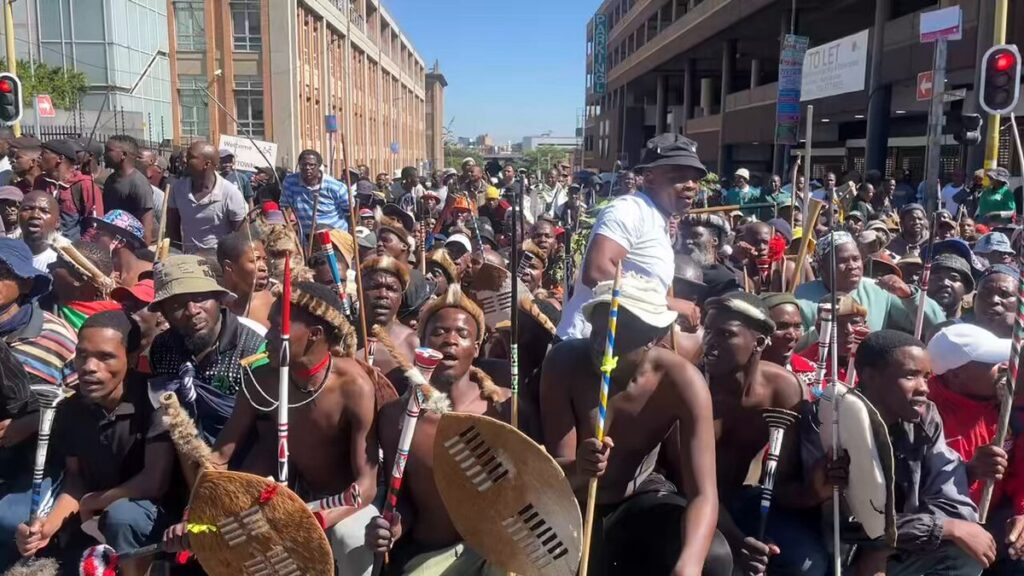
Protesters march through Johannesburg demanding stricter immigration enforcement. Photo credit: @visse_ss on x
For two days this week, hundreds of South Africans took to the streets of Pretoria and Johannesburg demanding something that should not require a protest march to achieve that the government enforce its own laws.
On Tuesday 28 April 2026, demonstrators marched through Pretoria. On Wednesday 29 April, the march moved to the Johannesburg CBD, where groups including March and March, Operation Dudula, ActionSA, and the Patriotic Alliance gathered at Mary Fitzgerald Square in Newtown before moving through the inner city. A memorandum was handed to Gauteng Premier Panyaza Lesufi. The government’s response was that work is underway to address the country’s porous borders.
The Unemployment Reality
South Africa has the highest unemployment rate in the world. More than 32 percent of South Africans who want to work cannot find employment. Among young people the figure is even more severe, with youth unemployment exceeding 60 percent in some measurements. These figures represent real people with qualifications, skills, and ambition who cannot access the labour market.
And yet both legal and illegal immigrants are finding employment in this same economy. The question South Africans are asking is a legitimate one. How, and why.
The Network That Shuts South Africans Out
What happens in practice is well documented by those who experience it daily. One immigrant secures employment at a business. When a position becomes available, that worker recommends a fellow countryman before the vacancy is advertised. The position is filled internally through a network of loyalty that consistently excludes local applicants before they have an opportunity to apply.
On the other side of this equation sit employers who deliberately seek out undocumented workers not for their skills but for their vulnerability. No contract. No UIF contributions. No minimum wage compliance. No recourse to the CCMA. An undocumented worker cannot report abuse without risking deportation, and certain employers exploit this reality systematically.
The Law Exists. The Enforcement Does Not.
South African law is clear. Section 38 of the Immigration Act makes it a criminal offence to employ an undocumented foreign national. Employers found guilty face fines of up to R50,000 per undocumented worker and potential imprisonment. These are not guidelines. These are laws with teeth.
So why are the employers not being arrested?
South Africa has labour inspectors whose mandate is to enter workplaces, verify employment status, and ensure compliance with both the Immigration Act and the Basic Conditions of Employment Act. Those officials are paid with public money. Yet the consistent pattern on the ground is that when enforcement does occur, it is the undocumented workers who are detained and deported while the employers who knowingly hired them face no meaningful consequence. The root of the problem the demand side of illegal employment is repeatedly left untouched.
South Africans are also reporting that their trade union processes are being disrupted. Workers who attempt to organise or raise grievances in workplaces with high numbers of undocumented employees find their efforts undermined, with union activity effectively placed on hold in environments where a significant portion of the workforce has no legal standing to participate in formal labour processes.
The Government’s Response
Government spokesperson William Baloyi this week stated that the government is strengthening measures to address illegal immigration including tightening border controls. South Africa deported 109,344 undocumented immigrants over the past two financial years.
That figure may sound significant. It becomes less impressive when measured against the scale of the problem, the years of similar assurances, and the fact that deportation without employer accountability simply creates a revolving door. Workers are removed. Employers face no sanction. New undocumented workers are hired. The cycle continues.
This Is Not About Hating Foreigners
It is necessary to state clearly what this argument is and what it is not. This is not an argument against immigration. This is an argument for the consistent application of South African law.
Legal immigrants who follow the correct channels, contribute to the tax base, and respect South African labour law are not the subject of this conversation. The subject of this conversation is a government that has selectively enforced its own legislation for years and created the conditions in which illegal employment thrives.
ActionSA’s Themba Mabunda stated at Wednesday’s march: “We are not xenophobic, we just want the right thing to be done in South Africa, to put the South African first. We do want to live with foreigners in our country, but those foreigners must be legally in the country.”
That is not a radical position. It is the position of citizens demanding that their government upholds the law it enacted.
The Double Standard South Africans Are Tired Of
When Botswana enforces its immigration laws, there are no international think pieces about Batswana xenophobia. When Nigeria acts against undocumented workers, no one holds a symposium on Nigerian hostility toward foreigners. When Kenya, Ghana, or Zimbabwe enforce their borders and their labour laws, it is understood as the normal functioning of a sovereign state.
When South Africa does it or attempts to a familiar pattern emerges. The marchers are labelled xenophobic. The protesters are portrayed as hostile rather than frustrated. South Africa is singled out for criticism that no other African country faces for doing exactly the same thing.
South Africans have noticed this double standard. They have been guilt tripped about it. They have been gaslit into believing that demanding the enforcement of their own country’s laws makes them bigots. And after years of this, a significant portion of the population has reached a point of indifference toward that label.
As protesters this week made clear, they intend to continue fighting for their country regardless of how the rest of the world chooses to characterise them. Some have stated openly that if standing up for South African workers and South African law means being called xenophobic, they will carry that label without shame.
That is not a sentiment born of hatred. It is a sentiment born of exhaustion. And until the government begins to enforce the law it wrote against employers, not just workers that exhaustion will continue to grow.
Editors Note This is an opinion piece representing the views of Mzansi Today Live. It does not represent the views of any political party or organisation. All factual claims are based on publicly available information at the time of publication.