

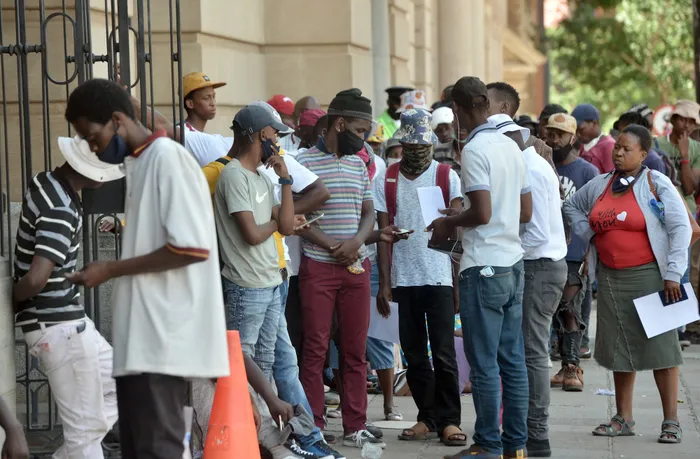
South Africa’s unemployment rate has risen to 32.7 percent in the first quarter of 2026 with 8.1 million people out of work according to the latest Statistics South Africa Quarterly Labour Force Survey. Image: oupa mokwena
South Africa shed 345,000 jobs in the first three months of 2026. The official unemployment rate has climbed to 32.7 percent up from 31.4 percent just three months ago. Youth unemployment now stands at 45.8 percent. That means nearly one in two young South Africans who want to work cannot find employment. There are 8.1 million unemployed South Africans. The jobless rate has been above 30 percent for more than five consecutive years. And the Government of National Unity, formed in 2024 with great fanfare and investor optimism, has struggled to meaningfully move the needle on job creation.
These are not just statistics. These are people. South African people. With qualifications, with ambition, with families to feed, sitting at home because the economy has no place for them.
The question that demands an answer and that very few in positions of power seem willing to ask directly is this: how is it possible that a country with the highest unemployment rate in the world is simultaneously a country where hundreds of thousands of people who are not citizens of that country are employed?
The Numbers Nobody Wants to Talk About
Walk into almost any restaurant in a South African city or town. Look at the kitchen staff, the waiters, the cleaners. Walk into a retail store in a township or a suburb. Look at the cashiers, the shelf packers, the security guards. Visit a construction site. Look at who is mixing the concrete and laying the bricks.
South Africans working in those environments will tell you what the statistics confirm indirectly that significant portions of minimum wage employment in the restaurant, retail, construction and domestic services sectors are occupied by individuals who are not South African citizens. Some are legally documented. Many, according to government’s own enforcement data, are not.
The question this raises is not one of xenophobia. It is one of economic policy and legal compliance. If South Africa’s Immigration Act makes it a criminal offence to employ an undocumented foreign national and it does, with penalties of up to R50,000 per worker and potential imprisonment for employers then why are those employers not being prosecuted? Why is enforcement consistently applied to the worker and not the employer who created the demand for illegal labour in the first place?
Is This Self-Inflicted?
There is a harder question that must be asked. Is South Africa’s unemployment crisis at least partly self-inflicted?
The argument being made in communities across the country, from Vosloorus to the Johannesburg CBD, from Khayelitsha to Soshanguve is a simple one. Employers who hire undocumented foreign nationals do so not because there are no South Africans available to do the work, but because undocumented workers are cheaper and more controllable. No UIF. No minimum wage compliance. No CCMA recourse. No right to organise or strike. An undocumented worker who complains can be reported to immigration authorities. An employer who knows this holds all the power.
And then there is the network effect. Once one foreign national is employed in a workplace, the pattern observed in community after community is that subsequent vacancies are filled through informal referral networks that consistently favour fellow nationals over local applicants who never even hear about the available positions.
If this pattern is as widespread as community organisations, spaza shop associations and anti-illegal immigration protest movements claim it is — and the frequency and scale of recent protests suggest the sentiment is widespread and growing — then the government has a responsibility to answer a direct question: is its failure to enforce its own laws contributing directly to the unemployment crisis it claims to be trying to solve?
What Is the Government Actually Doing?
The GNU has spoken about job creation. It has spoken about economic growth. It has spoken about investment and infrastructure. It has spoken about the Social Relief of Distress grant as a temporary measure. It has not spoken clearly and specifically about the enforcement of the Immigration Act in the labour market.
South Africa has labour inspectors. It has immigration officials. It has the Hawks. It has the Border Management Authority. It has an entire legal framework designed to regulate who may work in this country and under what conditions. The question is not whether the tools exist. The question is whether there is genuine political will to use themw consistently, without fear or favour, across sectors and suburbs and industries.
The GNU coalition includes parties with very different views on immigration and labour enforcement. The ANC has historically been reluctant to be seen as anti-immigrant given its own history of exile and solidarity with neighbouring countries. The DA has prioritised investor-friendly messaging that sometimes sits uneasily with aggressive labour market enforcement. ActionSA and the Patriotic Alliance have been among the most vocal advocates for stricter enforcement but are junior partners in the coalition.
The result of these competing interests is a government that issues statements about enforcement while the data tells a different story.
A Generation Being Written Off
Youth unemployment at 45.8 percent is not a statistic. It is a generation. It is 4.7 million young South Africans between the ages of 15 and 34 who do not have jobs. It is young people who finished school, who perhaps went to TVET colleges, who applied for positions and were told there was nothing available — while those positions were being filled through informal networks that excluded them before they could apply.
South Africa cannot sustain a social compact in which a growing share of the population has no economic stake in the system. The SRD grant keeps people alive. It does not give them dignity, purpose or economic participation. The gap between what the grant provides and what a minimum wage job provides is the difference between survival and agency.
The Questions That Must Be Answered
South Africans and their government need honest answers to the following questions.
How many undocumented foreign nationals are currently employed in South Africa’s formal and informal sectors? Government says it does not know. If it does not know, why not?
How many employers have been prosecuted under Section 38 of the Immigration Act in the past five years? If the number is negligible, what is the reason for that?
Is the government’s failure to enforce its own immigration and labour laws a matter of capacity, corruption or complicity?
And if the answer to that last question is complicity if certain industries, certain employers and certain political interests have benefited from a labour market in which the law is selectively applied then who is being held accountable?
South Africa’s unemployment rate is 32.7 percent and climbing. Eight million people are without work. A generation is being lost. The government owes South Africans not another press release about job creation targets. It owes them answers.
Editors Note This is an opinion piece representing the views of the Mzansi Today Live editorial team. All statistics cited are sourced from the Statistics South Africa Quarterly Labour Force Survey for Q1 2026, released on 12 May 2026. The views expressed do not represent those of any political party or organisation.