

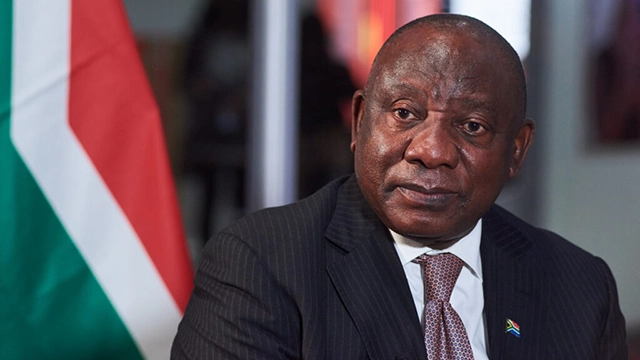
President Cyril Ramaphosa addressed the nation on Sunday evening declaring he will not resign following the Constitutional Court’s landmark Phala Phala ruling ordering Parliament to begin an impeachment inquiry. Photo: Getty
President Cyril Ramaphosa addressed the nation on Sunday evening, declaring he will not step down despite the Constitutional Court ordering Parliament to begin an impeachment inquiry into his conduct. The president has simultaneously launched a fresh legal bid against the Section 89 panel report as the ANC fractures over his future.
President Cyril Ramaphosa has told the nation he will not resign following the Constitutional Court’s landmark ruling on the Phala Phala scandal. Addressing South Africans on Sunday evening 11 May 2026, Ramaphosa was unequivocal about his intentions, declaring he intends to complete the mandate given to him by the South African people and that the rule of law guides his every decision.
“I remain here and am not resigning. May God continue to bless South Africa and protect her people,” Ramaphosa told the nation, pledging to do everything in his power to strengthen the institutions that uphold the rule of law so that they may never be used for criminality.
The Fresh Legal Bid
In a significant development that emerged hours after his national address, Ramaphosa launched a fresh legal bid against the Section 89 independent panel report that underpins the Constitutional Court’s impeachment ruling. The move signals that the president intends to use every available legal avenue to contest the process rather than allow it to proceed uncontested.
Legal analysts note that if Ramaphosa succeeds in having the high court review the Section 89 panel report, it could effectively tie Parliament’s hands during the impeachment inquiry process since the very report Parliament is required to consider would be subject to active judicial review. The outcome of that legal bid is uncertain and would itself likely be subject to further litigation.
A source in the Presidency told Business Day that the president was weighing his options carefully and in accordance with the law. “The president is weighing his options right now in accordance with the law,” the source said.
What the Constitutional Court Ruled
The Constitutional Court delivered its landmark ruling on Friday 8 May 2026, finding that Parliament acted unconstitutionally when it voted in December 2022 to block an impeachment inquiry into Ramaphosa over the Phala Phala scandal. Chief Justice Mandisa Maya ruled that parliamentary rule 129I was inconsistent with the Constitution and set aside the National Assembly vote of 13 December 2022, in which ANC members used their parliamentary majority to defeat the adoption of the Section 89 independent panel report.
The court ordered that the report must now be referred to an impeachment committee of the National Assembly. The ruling does not remove Ramaphosa from office and does not constitute a finding of guilt. It requires Parliament to conduct the formal investigation that the independent panel had originally recommended.
The scandal at the centre of the inquiry relates to the alleged theft of approximately $580,000 concealed in a sofa at Ramaphosa’s Phala Phala game farm in Limpopo in 2020. Critics have long argued that Ramaphosa failed to report the theft through official channels as required by law, and that the origin of the money raises questions that have never been adequately answered. Ramaphosa has consistently maintained that the money represented proceeds from the legitimate sale of buffalo on his farm.
A Party Divided
The Constitutional Court ruling has exposed deep fractures within the African National Congress. While ANC Secretary-General Fikile Mbalula moved quickly to reaffirm the party’s support for Ramaphosa following the ruling, rival factions within the party have called publicly for the president to step down.
Internal critics have argued that a leader facing a formal parliamentary impeachment inquiry would be untenable for the ANC particularly with local government elections scheduled for 4 November 2026 fast approaching. The concern within those factions is that the impeachment process, however it ultimately concludes, will dominate the political landscape for months and damage the ANC’s prospects at the polls.
ANC spokesperson Mahlengi Bhengu sought to maintain a careful line, noting that the court did not pronounce on the merits of the Phala Phala matter itself and made no findings on the guilt or innocence of Ramaphosa. The party added that it was considering its options on the way forward.
Deputy President Paul Mashatile has emerged as the frontrunner in discussions about who might replace Ramaphosa should he ultimately be removed or choose to step aside. Political analysts note that Mashatile’s positioning has become increasingly prominent as the Phala Phala matter has escalated in recent days.
Opposition Reacts
The EFF, which brought the case to the Constitutional Court alongside the African Transformation Movement, celebrated the ruling as a major victory. EFF leader Julius Malema characterised it as confirmation that the ANC had abused its parliamentary majority to shield its leader from constitutional scrutiny. “You cannot vote to protect criminality. You cannot vote to protect corruption because every vote must be accompanied by rationality,” Malema said.
The MK Party was equally vocal. MK Party spokesperson Nhlamulo Ndhlela called Ramaphosa a “constitutional delinquent” who should resign immediately. The characterisation drew pointed commentary from analysts who noted the irony of the statement coming from a party led by former President Jacob Zuma who himself refused to resign as president when the Constitutional Court ruled that the Public Protector’s findings against him over misspending at his Nkandla home were binding.
The Democratic Alliance, which had entered into the Government of National Unity with the ANC following the 2024 elections, said it would study the full judgment before commenting. The DA has previously been outspoken in its criticism of Ramaphosa over Phala Phala but shifted its public posture significantly after joining the GNU.
What Happens Next
Parliament must now establish an impeachment committee to consider the Section 89 panel report. Chief Justice Maya noted during the ruling that such a process could take many months to complete. Political analysts have observed that all parties in Parliament will use the occasion to advance their own positions ahead of the November local government elections, making a swift and quiet resolution of the matter unlikely.
For an impeachment to succeed and Ramaphosa to be removed from office, a two-thirds majority vote in the National Assembly would be required. Given the current composition of Parliament, where the ANC and its GNU partners collectively hold a significant majority, the prospect of that threshold being reached remains a matter of considerable political debate.
Ramaphosa himself came close to resigning when the Section 89 panel report was first published in June 2022, until senior ANC leaders persuaded him against doing so. On Sunday evening, he gave no indication of wavering from his determination to remain in office and fight the process through every available legal and constitutional channel.
Editors Note President Cyril Ramaphosa has not been charged with or convicted of any criminal offence in connection with the Phala Phala matter. The Constitutional Court’s ruling relates to Parliament’s procedural conduct and does not constitute a finding of guilt against the president. All persons are presumed innocent until proven guilty in a court of law. Mzansi Today Live will update this article as further information becomes available.