

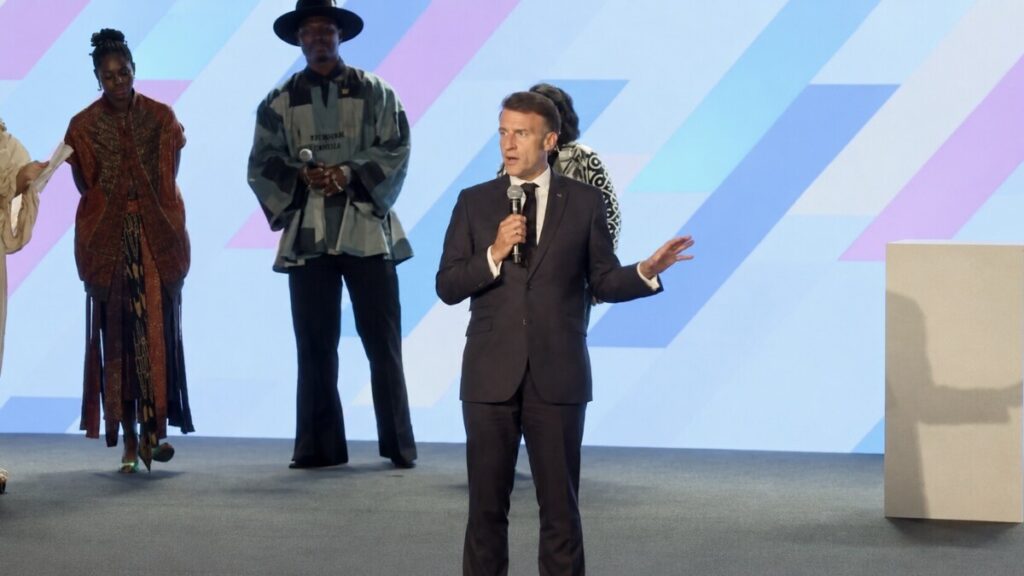
French President Emmanuel Macron addresses the Africa Forward Summit at the University of Nairobi on Monday 11 May 2026 after interrupting proceedings to reprimand a noisy audience. Photo credit: entrevue.fr
French President Emmanuel Macron is at the centre of two contrasting conversations emerging from the Africa Forward Summit in Nairobi this week. The first is a viral video of the French president taking the microphone to publicly reprimand a noisy audience at the University of Nairobi, a moment that has divided global opinion. The second is a deepening diplomatic tension between France and South Africa after Macron rescinded South Africa’s invitation to the G7 summit in France in June while extending a separate invitation to Kenya’s President William Ruto a move that has prompted President Cyril Ramaphosa to signal he will not attend the Nairobi summit.
The Moment That Went Viral
During a youth forum side event at the University of Nairobi on Monday 11 May 2026, Macron abruptly rose from his seat while a speaker was addressing the audience on culture. Presenters were caught off guard by the unexpected intervention.
“Already? You are not waiting for your time?” a presenter asked as she handed him the microphone, assuming he wished to address the forum ahead of schedule.
Macron had other intentions. Visibly frustrated by the noise levels in the auditorium, he addressed the audience directly.
“Excuse me, everybody, hey, hey. I’m sorry, but it is impossible to speak about culture and to have people like that super inspired coming here, making a speech with such noise. This is a total lack of respect,” Macron told the audience. “I suggest that if you want to have a chat about something else, you have bilateral rooms or you go outside.”
The hall fell silent. Sections of the audience applauded as Macron handed back the microphone and returned to his seat. A moderator at the event responded to the moment by saying “And this, ladies and gentlemen, is cold leadership.”
The video of the incident spread rapidly across social media, with reactions divided between those who praised Macron for defending the dignity of African speakers on stage and those who characterised the intervention as condescending, particularly given France’s complicated history on the African continent.
What the Africa Forward Summit Is About
The Africa Forward Summit, co-hosted by Macron and Kenyan President William Ruto at the Kenyatta International Convention Centre and the University of Nairobi on 11 and 12 May 2026, is being held for the first time in a non-Francophone African country since the summit’s inception in 1973. The decision to host the gathering in Kenya a former British colony rather than a former French territory is itself a statement of intent from Paris.
The summit has drawn 30 African heads of state and more than 1,500 economic and institutional leaders from Africa and France. Discussions are focused on artificial intelligence, renewable energy, infrastructure investment, education reform and digital innovation a deliberate pivot from the security partnerships and patronage arrangements that defined France’s post-colonial engagement on the continent for decades.
Kenya and France signed 11 bilateral agreements on the eve of the summit on Sunday, covering investments in nuclear energy, modernised transport and sustainable agriculture. Ruto said Nairobi was “neither looking East nor West” but “looking forward” a diplomatic formulation aimed at positioning Kenya as a non-aligned partner in an increasingly competitive geopolitical landscape.
France’s Declining Influence: The Context Behind the Summit
The Africa Forward Summit is not taking place in a vacuum. It is taking place in the shadow of France’s most significant loss of influence on the African continent since decolonisation. French troops have been expelled from Mali, Burkina Faso, Niger and most recently Senegal, where a 65-year French military presence ended in 2025 after the election of President Bassirou Diomaye Faye on a platform of anti-neo-colonial transformation.
With no permanent military presence in West or Central Africa and mounting anti-French sentiment across the Sahel, Macron has pivoted to Anglophone Africa in search of new partners and new markets. Critics have been blunt in their assessment of this strategy. Political analyst Kim Heller has argued that France’s rhetoric of mutual cooperation and shared development masks a more self-serving agenda focused on resource extraction and geopolitical positioning the same pattern, critics argue, that caused France’s expulsion from its traditional sphere of influence in the first place.
Kenyan opposition leader Kalonzo Musyoka also weighed in, slamming the choice of Kenya as the summit venue. “There will be an air of pretence that we are a cohesive nation,” Musyoka said. “We know that is far from the truth.” He described Kenya as a country where democracy remains under threat, the opposition is under attack and human rights are being violated even as the country prepares for the 2027 general election.
The South African Snub
The development that has attracted the most attention in South African circles is a diplomatic snub with direct implications for the bilateral relationship between Pretoria and Paris. Macron extended an invitation to Kenya’s President Ruto to attend the G7 summit in France in June 2026 while simultaneously rescinding a previously extended invitation to South African President Cyril Ramaphosa.
The withdrawal of the South African invitation is widely understood to be connected to South Africa’s foreign policy positions, including its case against Israel at the International Court of Justice and its broader non-aligned posture on global geopolitical issues. Ramaphosa is expected to skip the Africa Forward Summit in Nairobi as a result of the diplomatic tension between the two countries.
The snub has raised questions about the nature of France’s new Africa strategy and whether the language of partnership and equality applies selectively depending on which African governments align most closely with French and broader Western interests.
Macron’s Morning Run With Kipchoge
Not all of Macron’s moments in Nairobi have been controversial. On Monday morning, the French president was photographed jogging alongside celebrated Kenyan marathon champion Eliud Kipchoge in what was billed as a symbolic moment of cultural exchange and sporting diplomacy. During the run, a young Kenyan boy approached Macron and asked for his name a heartwarming exchange that circulated widely on social media alongside the more contentious reprimand video.
What Comes Next
The Africa Forward Summit continues on Tuesday 12 May 2026. The outcomes of the gathering particularly any commitments on investment, debt relief and technology transfer will be measured against the lofty language of partnership and equality that has defined its framing. For France, the summit represents an opportunity to rebuild credibility on a continent that has increasingly turned its back on Paris. Whether the substance of the agreements signed in Nairobi will match the ambition of the rhetoric remains to be seen.
Editors Note All information in this article is based on publicly available reports and statements from the Africa Forward Summit in Nairobi as at 11 May 2026. The views of analysts and opposition figures cited in this article are their own and do not represent the editorial position of Mzansi Today Live.