

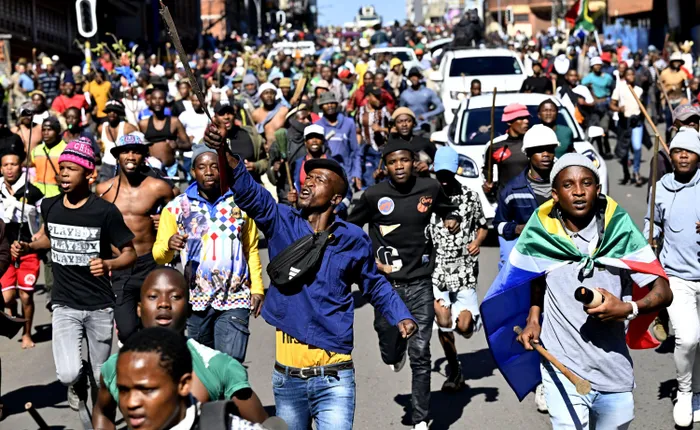
Anti-immigration protests are underway across South Africa on Tuesday 30 June 2026 as the deadline set by the March and March Movement for undocumented foreigners to leave the country arrives. Image: Itumeleng English / ANA Studio
Anti-immigration protests are underway across South Africa on Tuesday 30 June 2026. The deadline set by the March and March Movement for undocumented foreigners to leave the country has arrived. The 30 June protests South Africa have spread to Johannesburg, Durban, Cape Town, Gqeberha, Mthatha, Komani, Kroonstad and KuGompo City. Furthermore, the government has declared the day a normal working day, dismissing speculation of a nationwide shutdown. As a result, South Africa is experiencing one of its biggest security operations in years while authorities report no major incidents by mid-morning.
30 June Protests South Africa: What Is Happening on the Ground
Marches got underway from multiple starting points on Tuesday morning. In Johannesburg, protesters marched from Bayers Naude Square through Hillbrow to Constitution Hill. In Durban, activists gathered at King Dinuzulu Park before marching through the city. Furthermore, demonstrations took place in Gqeberha, Mthatha, Komani and Kimberley, where marchers walked from the Kemo Hotel to the premier’s office. As a result, the protests reached nearly every major South African city by mid-morning.
Stun grenades were fired on protesters in Kraaifontein, Cape Town. Two marching groups had converged on a police station and turned riotous after handing over a memorandum. Furthermore, a shop was looted in Delft, and police monitored a separate protest at St George’s Cathedral in the Cape Town CBD. In Johannesburg, Gauteng deputy police commissioner Major General Fred Kekana confirmed that protest leaders, including Ngizwe Mchunu, pleaded with police to intervene against an unruly crowd. Leaders complained that some marchers were under the influence of alcohol. As a result, police diverted that group to KwaMai-Mai.
No Major Incidents by First Light
Despite weeks of anxiety and viral misinformation predicting widespread violence, police reported no major incidents linked to the protests by first light on Tuesday. In Mpumalanga, police spokesperson Lieutenant Colonel Jabu Ndubane confirmed there had been no incidents beyond an armed robbery in Standerton. Limpopo police spokesperson Brigadier Hlulani Mashaba confirmed no violent incidents had occurred and dismissed a viral video claiming to show looting in Steelpoort as old, recycled footage.
The Western Cape also reported calm. Provincial traffic chief Maxine Bezuidenhout reported no disruptions as of 5.25am. Mossel Bay municipal spokesperson Cornelle Carstens and Overstrand Mayor Archie Klaas also reported no incidents by early morning. However, Klaas confirmed he had received intelligence on Monday warning of possible major disruptions. As a result, the overall picture by mid-morning showed tension and heavy security presence rather than the mass unrest many had feared.
The Government’s Response to the 30 June Protests
The South African government declared on Monday that Tuesday 30 June would remain a normal working day. “Tuesday, 30 June 2026 remains a normal working day. Public services, schools and businesses are expected to continue operating as normal,” the government said in a statement on its official X account. Furthermore, authorities urged residents to rely on verified government information after fact-checkers dismissed viral, AI-generated social media posts as fabricated misinformation designed to spread panic.
The government deployed thousands of police and soldiers across the country at a cost of R600 million and rising. Police confirmed 15,384 arrests nationwide between 22 and 28 June. That figure includes 2,884 foreign nationals held for immigration offences. Officers also made 146 arrests for murder, 111 for rape and more than 1,100 for assault. They seized 101 unlicensed firearms. Furthermore, NatJoints recorded at least 103 cases of anti-immigrant violence and made 195 arrests since 1 March 2026. As a result, the security operation around 30 June ranks among the biggest coordinated law enforcement deployments in South Africa’s recent history.
Explosives Found at Beitbridge
In a major development tied to the heightened security climate, officials arrested a 39-year-old Malawian bus driver, Gondwe Samson Tonne, at the Beitbridge border post. They allegedly found explosives worth R100,000 hidden in bags of rice. The Border Management Authority recovered four reels of detonating cord. Furthermore, the Musina Magistrate’s Court remanded Tonne in custody. NPA spokesperson Mashudu Malabi commended the BMA for its vigilance in safeguarding the country’s ports of entry.
More Than 25,000 Foreigners Have Already Left
More than 25,000 foreign nationals have already left South Africa ahead of the deadline through voluntary repatriation programmes organised by their home governments. Furthermore, thousands more have fled their homes and taken refuge in repatriation centres, consulates and makeshift camps in cities including Durban and Mossel Bay. As a result, the scale of departure ahead of 30 June reflects the genuine fear gripping migrant communities, regardless of the government’s insistence that no legal deadline exists.
In Limpopo, police arrested a 48-year-old farm owner and 15 undocumented workers for contravening the Immigration Act during a compliance inspection at a farm in Trichardsdal on Monday. As a result, formal immigration enforcement continued alongside the protest activity rather than running separately from it.
The Shadow of 2008 and 2021
Tuesday’s events draw heavy comparison to two previous moments of crisis in South African history. In 2008, mob violence in Alexandra, Johannesburg spread into two weeks of attacks. The unrest killed 62 people, injured hundreds and displaced more than 100,000. In 2021, riots following former President Jacob Zuma’s imprisonment killed more than 350 people and caused an estimated R50 billion in economic damage. Furthermore, security planners flagged several high-risk flashpoints ahead of 30 June, including the Johannesburg CBD and Hillbrow, the N1, N3 and N12 freight corridors in Gauteng, Durban and Pietermaritzburg, Mossel Bay, Kleinmond and Gansbaai in the Western Cape, and KuGompo City. As a result, the entire country remained on high alert for the possibility of a repeat of either of those events.
A NatJoints spokesperson said the state was prepared. “The state is ready, and law enforcement is ready. Physical infrastructure will be protected and maintained, and our operators are on the ground,” she said.
What Happens Next After the 30 June Protests
Protest organisers listed official march starting points across the country, all carrying instructions that no weapons were permitted. The Eastern Cape Development Corporation advised businesses in the Buffalo City Metro to close temporarily as a precautionary measure. Furthermore, voluntary repatriations continued in Cape Town even as marches got underway. As a result, the day is expected to unfold in phases. The true test will be whether protests remain peaceful into the afternoon and evening as crowds grow larger and tensions potentially rise.
Editors Note This is a live and rapidly developing story. All information in this article is based on confirmed reports from SAPS, NatJoints, the Border Management Authority and media reports as at the morning of 30 June 2026. Mzansi Today Live will update this article continuously as the day unfolds.