

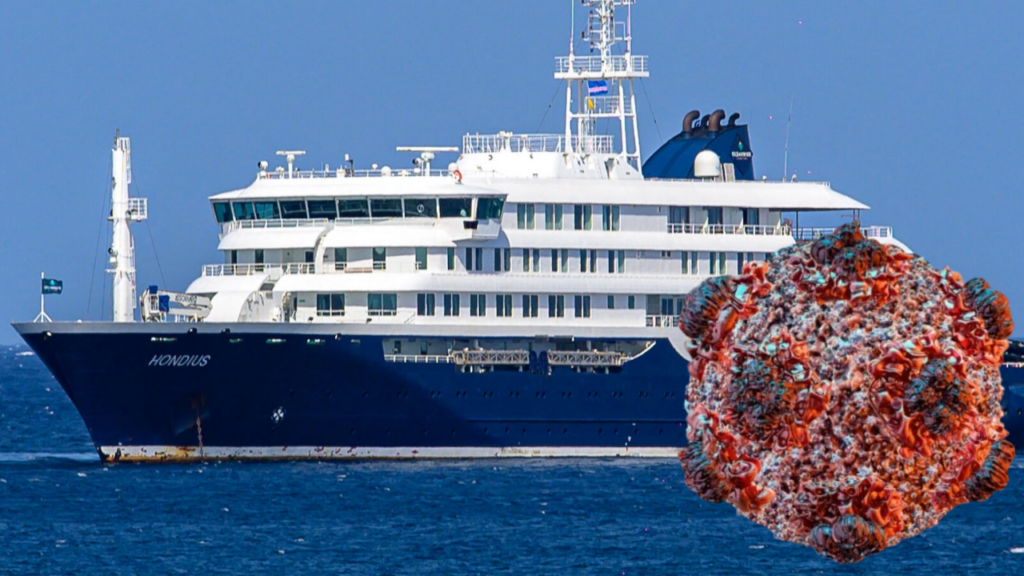
Three passengers have died and a British national is in critical condition in Johannesburg after a hantavirus outbreak struck the cruise ship MV Hondius in the Atlantic Ocean. Image: Getty Images/Edited by T Mabaso
A suspected hantavirus outbreak aboard a Dutch-flagged expedition cruise ship has killed three passengers and left a British national in critical condition in a Johannesburg hospital. South Africa’s National Institute for Communicable Diseases has launched contact tracing in the Johannesburg region as the World Health Organization monitors the situation closely.
A rare and deadly hantavirus outbreak aboard the MV Hondius, a Dutch-flagged expedition cruise ship operated by Oceanwide Expeditions, has killed three people and infected at least two others in what health authorities are describing as an unusual and concerning cluster of cases in the Atlantic Ocean. A British national who was evacuated to Johannesburg is in critical condition in a private medical facility in the city, and South Africa’s health authorities have launched contact tracing operations in the Johannesburg region to determine whether other individuals may have been exposed.
What Is the MV Hondius
The MV Hondius is a Dutch-flagged expedition cruise ship that departed Ushuaia in Argentina on 1 April 2026 carrying 149 people representing 23 different nationalities, including 88 passengers and 61 crew members. The vessel made stops in Antarctica before returning briefly to Ushuaia and then travelling north through some of the Atlantic Ocean’s most remote island territories, including Saint Helena and Ascension Island, both British overseas territories, before anchoring off Praia, the capital of Cape Verde, an island nation off the west coast of Africa.
The ship is currently being refused permission to disembark its passengers by Cape Verde authorities as investigations and medical evacuations continue.
The Deaths
The first known fatality was a 70-year-old Dutch man who died aboard the ship. His body was disembarked at Saint Helena on 24 April 2026. His wife, a 69-year-old Dutch woman who was a close contact, developed gastrointestinal symptoms and went ashore at Saint Helena on 24 April. She subsequently deteriorated during a flight to Johannesburg, South Africa, on 25 April and died upon arrival at the emergency department on 26 April. She later tested positive for hantavirus by PCR test, confirmed on 4 May 2026. Contact tracing for passengers on that flight has been initiated by South African health authorities.
A German national died aboard the ship on 2 May 2026. While his cause of death had not been formally established at the time of publication, the case is being treated as a suspected hantavirus infection by health authorities.
The British Patient in Johannesburg
A British national fell ill near Ascension Island on 27 April 2026 with febrile illness, shortness of breath and signs of pneumonia. He was medically evacuated from Ascension Island to South Africa on 27 April and is currently hospitalised in an Intensive Care Unit at a private medical facility in Johannesburg. Laboratory testing confirmed hantavirus infection on 2 May 2026 by PCR test. He is described as being in critical condition. He is the second laboratory confirmed hantavirus case linked to the outbreak.
The British Foreign, Commonwealth and Development Office had been contacted for comment at the time of publication.
South Africa’s Response
South Africa has become a central point in the international response to the outbreak given that two of the confirmed cases were brought to Johannesburg for medical treatment. South Africa’s National Institute for Communicable Diseases is conducting contact tracing in the Johannesburg region to identify whether any individuals who may have come into contact with the infected passengers on South African soil have been exposed to the virus.
South Africa’s Department of Health has confirmed its awareness of and involvement in the coordinated international response to the outbreak. Serology, sequencing and metagenomics investigations are ongoing to better understand the specific strain of hantavirus involved and its likely source.
What Is Hantavirus
Hantavirus is a rare but potentially fatal disease primarily carried by rodents. Humans become infected through contact with the urine, faeces or saliva of infected rodents, or through breathing in air contaminated with rodent droppings in enclosed spaces. The virus causes two serious syndromes hantavirus pulmonary syndrome, which severely affects the lungs, and haemorrhagic fever with renal syndrome, which severely affects the kidneys.
There is no specific treatment or cure for hantavirus infection. Early medical attention significantly increases the chance of survival. While human-to-human transmission is rare, one specific strain the Andes virus, found primarily in Chile and Argentina has been documented to spread between people in limited circumstances. It is not yet confirmed which strain is responsible for the current outbreak, though the ship’s origins in South America have drawn the attention of investigators.
Hantavirus is endemic in parts of Argentina and Chile. The Ministry of Health of Argentina’s Tierra del Fuego province, where the ship originated in Ushuaia, stated that there has never been a confirmed case of hantavirus in that province. However, the virus is present in other parts of Argentina, including the Patagonian town of Epuyén, which experienced a significant outbreak in 2018 and 2019 resulting in at least 11 deaths.
The Current Situation on Board
As of 4 May 2026, the MV Hondius remains anchored off Praia, Cape Verde, with 149 people on board. Cape Verde authorities have refused to allow passengers to disembark. Two crew members one British and one Dutch national are experiencing acute respiratory symptoms and are set to be medically evacuated. One crew member’s symptoms are described as mild, the other as severe. Three additional suspected cases on board have reported high fever and gastrointestinal symptoms. Medical teams in Cabo Verde are evaluating patients and collecting specimens for further testing.
Travel blogger Jake Rosmarin, who remains on the ship, appealed for public understanding in an emotional social media post. “What’s happening right now is very real for all of us here. We’re not just a story,” he said.
WHO Risk Assessment
The World Health Organisation has assessed the risk to the global population from this outbreak as low. The WHO is working with national health authorities from Cabo Verde, the Netherlands, South Africa, Spain and the United Kingdom to coordinate the response, including case isolation, medical evacuations and laboratory investigations.
WHO Regional Director for Europe Hans Kluge stated clearly that the outbreak does not represent a broader public health threat. “There is no need for panic or travel restrictions,” Kluge said.
What Happens Next
Investigators are working to determine the source of the outbreak and the specific strain of hantavirus involved. Sequencing results are expected to provide more clarity in the coming days. South Africa’s contact tracing efforts in Johannesburg will continue until all individuals who may have been exposed are identified and assessed.
Editors Note This is a developing story. All case numbers and fatality figures referenced in this article are based on WHO and Oceanwide Expeditions statements as at 4 May 2026. Information may change as investigations progress. Mzansi Today Live will update this article as further information becomes available.