

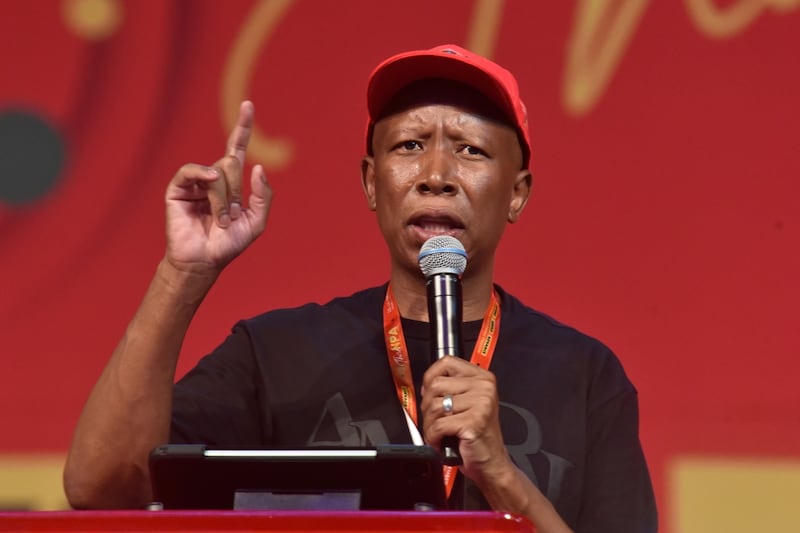
EFF leader Julius Malema has compared himself to Nelson Mandela after receiving a five-year prison sentence for firearm charges. Picture: Freddy Mavunda
EFF leader Julius Malema compares himself to Mandela, Walter Sisulu and Oliver Tambo after receiving a five-year prison sentence for firearm-related charges. Malema made the comparison at an EFF Youth campaign event, claiming political prisoner status and insisting he committed no crime. “I’m on the same status like Mandela, Sisulu and Tambo. I didn’t do any crime or kill anyone. I’m arrested for politics,” he said.
The East London Magistrate’s Court sentenced Malema to five years in prison on 16 April 2026. His conviction stemmed from a 2018 rally incident in which he discharged a firearm in a public place. Malema had argued the weapon was a toy, but the court rejected that defence and handed down the sentence. Legal analysts say the appeal process could take years to conclude.
Moreover, Malema used the occasion to frame his legal troubles as state persecution rather than a criminal matter. “I’m not your president. I’m a political prisoner. I was arrested for things I did in a political party,” he told supporters. He further dared authorities by suggesting they would need to reopen Robben Island if they intended to imprison him, drawing a direct parallel to the imprisonment of anti-apartheid leaders during the apartheid era.
Malema Says Mandela Is No More as He Targets the ANC and MK Party
Separately, Malema invoked Mandela’s name at the EFF’s KwaZulu-Natal Provincial Manifesto Rally in Inanda on 20 September 2026. Speaking ahead of the November 4 municipal elections, he urged voters to move on from the past and embrace a new generation of leadership. He told the crowd that Mandela was gone, that Zuma was too old to lead, and that the future belonged to the EFF and to their children.
Furthermore, Malema used the KZN rally to take aim at both the ANC and the MK Party. He called for the EFF to take over municipalities across the country, including Cape Town, where the DA has long held power. As a result, his campaign messaging positioned the EFF as the only party capable of delivering genuine economic freedom to South Africans ahead of the elections.
In addition, Malema’s political prisoner claim divided South Africans sharply. Critics rejected the Mandela comparison outright, arguing there is no equivalence between apartheid-era political imprisonment and a firearm conviction arising from a rally stunt. Supporters, however, rallied behind him, with thousands gathering outside the East London court in April carrying placards reading “We stand with Julius Malema.”
Malema’s Parliamentary Future Hangs on His Appeal
A prison sentence of more than 12 months disqualifies a sitting member of parliament from holding their seat. Therefore, Malema’s five-year sentence, if it survives his appeal, would end his parliamentary career. The EFF holds approximately 10% of parliamentary seats, and political analysts have warned the party would struggle significantly without Malema leading it. His appeal means he remains free and active in politics while the legal process continues.
Consequently, the comparison to Mandela drew its own wave of public debate. Many South Africans said the remarks were disrespectful to Mandela’s legacy and trivialised the suffering of those imprisoned during apartheid. Others argued the justice system was being used as a political tool against opposition figures. The controversy follows Malema into the election campaign as he attempts to consolidate EFF support ahead of November.
Read also: Patriotic Alliance Revives Abahambe Before Municipal Elections