

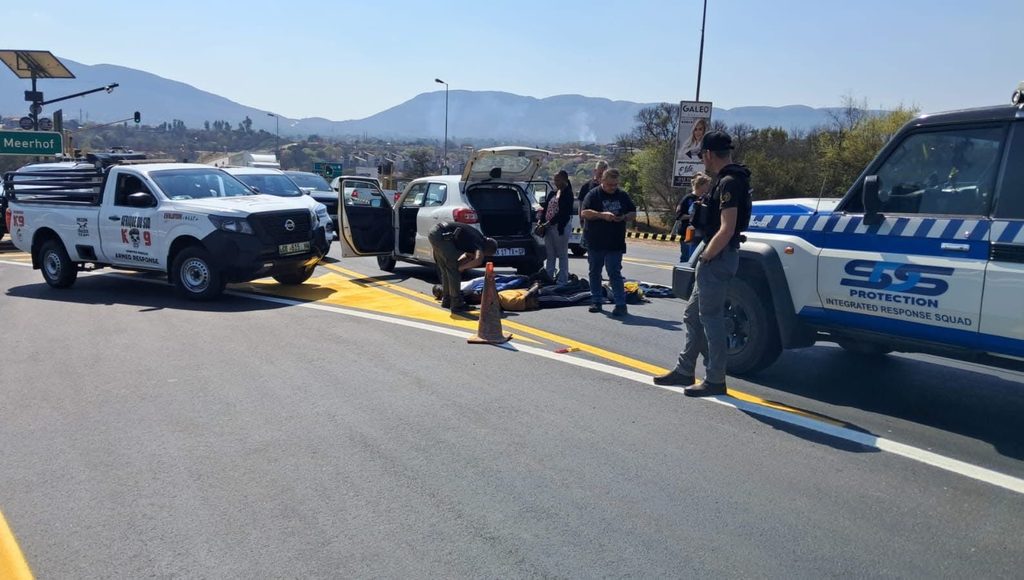
Four suspected railway cable thieves were arrested on the R511 at Meerhof near Hartbeespoort in the North West on Wednesday 27 August 2026 after security officers tracked their vehicle and coordinated an interception with SAPS. Image: SAPS/Supplied
Four suspected railway cable thieves are in custody after security officers tracked their vehicle on the R511 at Meerhof near Hartbeespoort in the North West. The Hartbeespoort railway cable theft bust happened on Wednesday 27 August 2026 when security officers coordinated an interception with SAPS on the R511 at Meerhof. As a result, four suspects now face charges for stealing railway infrastructure.
Security officers received information about a vehicle carrying suspected stolen railway cable in the Hartbeespoort area. They tracked the vehicle and alerted SAPS. Officers stopped it on the R511 at Meerhof and found railway cable inside. All four occupants faced arrest at the scene. Furthermore, officers recovered the stolen cable as part of the operation. As a result, the suspects face criminal charges and the cable will serve as evidence in their case.
Railway cable theft is one of the most destructive crimes in South Africa. Thieves strip copper and aluminium cable from railway lines, signalling systems and power infrastructure. That causes train delays, derailments and sometimes complete shutdowns of railway lines for days or weeks. Repairs are expensive and slow. Furthermore, stolen signalling cable means train drivers cannot tell whether the track ahead is clear. As a result, cable theft does not only cost money. It puts lives at risk every time it happens.
Prasa has lost billions of rands worth of infrastructure to cable theft over the past decade. The Metrorail network in Gauteng suffered repeated shutdowns of entire rail corridors. The Mabopane and Naledi lines suffered the most. Trains that once carried hundreds of thousands of commuters now run at a fraction of their former capacity. Furthermore, commuters who cannot afford private transport moved to overcrowded buses and minibus taxis, adding hours to their daily journeys. As a result, cable theft is not just a crime against a state entity. It is a crime against the working poor who depend on affordable rail transport to survive.
The Hartbeespoort area has seen several infrastructure crimes in recent years. The R511 corridor connects the North West and Gauteng and criminal networks use it to move stolen cable out of the area quickly. Security companies in the region invested in vehicle tracking and rapid response coordination with SAPS to catch cable thieves before they offload their haul. Wednesday’s Hartbeespoort railway cable theft arrest shows that approach can work. Furthermore, the coordination between private security and SAPS on the R511 is the kind of public-private partnership that law enforcement experts have called for. As a result, the four arrests show what coordinated rapid response can achieve.
Cable theft syndicates in South Africa are well organised. They use lookouts, multiple vehicles and planned escape routes. They target specific railway sections based on knowledge of patrol schedules and response times. Furthermore, stolen cable rarely stays in South Africa. Criminal networks move it across borders into neighbouring countries where informal metal markets melt it down and make it impossible to trace. As a result, catching cable thieves at the point of theft, as happened in Hartbeespoort on Wednesday, is far more effective than trying to trace stolen material afterwards.
Editors Note All four suspects are presumed innocent until proven guilty in a court of law. No court has proven any of the charges.