

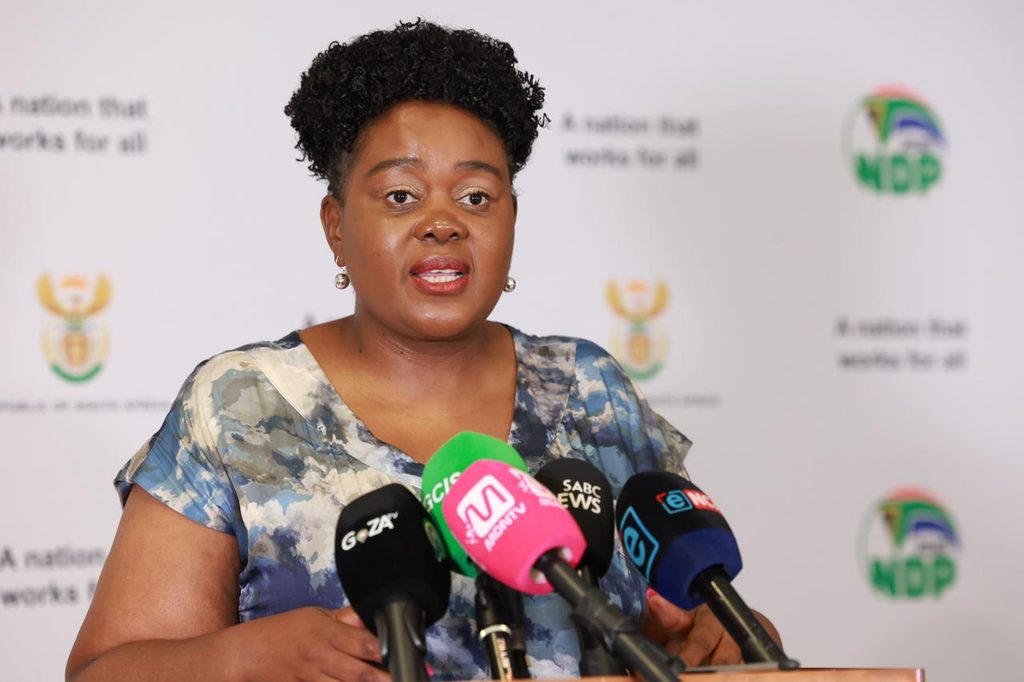
Justice Minister Mmamoloko Kubayi, who chairs the inter ministerial committee on migration, briefs the media in Pretoria. Image credit SAgovernews
Government has warned that people who use social media to incite violence, intimidate foreign nationals or mobilise unlawful activities will face the consequences of their actions. The online incitement warning comes as tensions over migration and asylum applications continue across the country.
The inter ministerial committee on migration issued the warning after a media briefing in Pretoria on Sunday. Justice Minister Mmamoloko Kubayi, who chairs the committee, said the Constitution protects freedom of expression but does not protect incitement. According to Kubayi, government will not tolerate incitement to violence, intimidation, hate speech or criminal conduct.
She added that such conduct may amount to a criminal offence and that authorities will deal with it according to the law. However, the committee did not name any specific law or say whether anyone faces charges for posts made so far.
What the online incitement warning means
The committee says it is concerned about inflammatory and misleading content on digital platforms. In its view, some of this content could stir up hostility against foreign nationals, public officials and state institutions.
As a result, law enforcement agencies are monitoring developments closely. According to the committee, police will act against anyone who encourages, organises, helps or commits violence and public disorder, whether online or offline.
At the same time, the committee stressed that South Africans still have the right to protest. Peaceful protest remains protected. However, intimidation, looting, damage to property, public violence and blocking lawful activities are not. Kubayi said people must deal with questions of asylum, migration and border control through lawful processes.
The committee also met with six organisations during the week. These were Operation Dudula, March and March, the United Civic Movement, the South African Council of Churches, South Africa First and the Alexander Fiela Movement. In addition, it called on the public, civil society, community groups and political leaders to show restraint while legal processes continue.
Furthermore, Kubayi confirmed that deportations will continue. Officials will deport people who entered the country illegally and never applied for asylum. Similarly, they will deport people whose asylum claims have been finally rejected after review or appeal.
The warning follows a week of unrest. On 28 September, Home Affairs issued a directive that told refugee reception offices to accept new asylum applications, including from people who entered the country illegally. The directive followed a Constitutional Court judgment on 7 July, which struck down parts of the Refugees Act.
Then, last Thursday, protests turned violent in Durban and Soweto. Protesters torched 24 vehicles, and looters targeted foreign owned shops. Home Affairs withdrew the directive on Friday. Since Thursday, police have arrested 30 people, including three Ethiopian nationals who allegedly fired guns in KwaZulu-Natal.
Government now plans to ask the courts for a supervisory order to guide how it carries out the judgment. It also wants to strengthen the capacity of Home Affairs to handle asylum applications. Meanwhile, the committee urged the public to rely on official sources and to reject misinformation.
Read more