

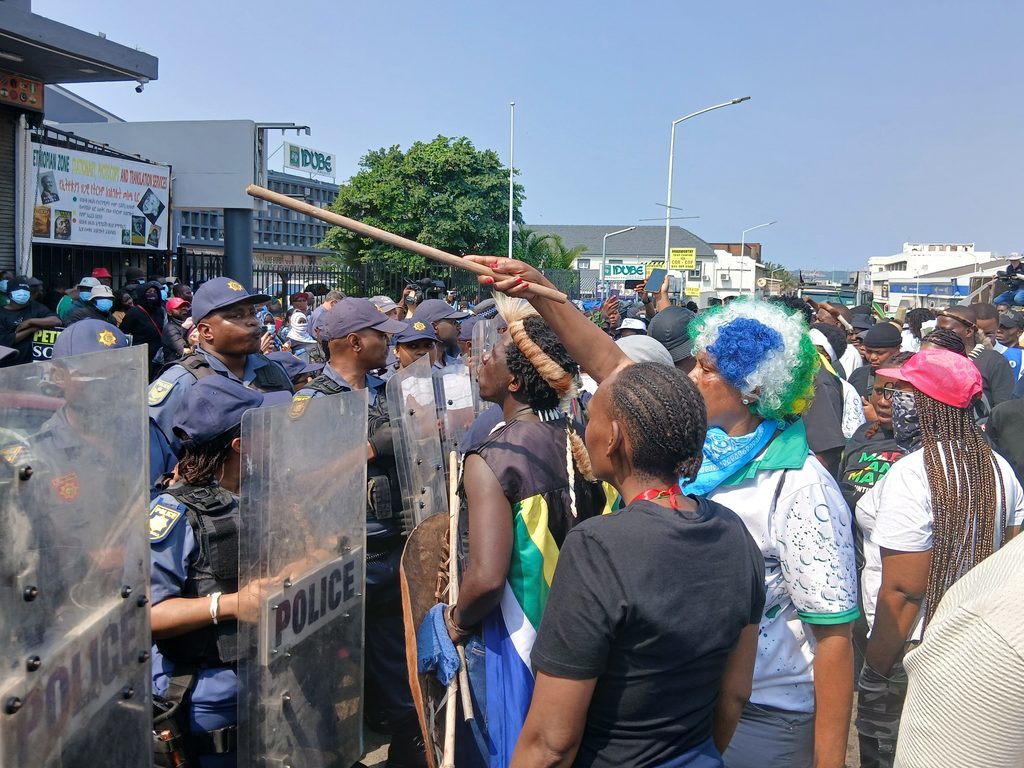
Protesters outside the Home Affairs Refugee Reception Centre in Durban warn their numbers will double on Thursday until the Constitutional Court reconsiders its asylum ruling. Image credit Tsoanelo Sefoloko
Protesters outside the Home Affairs Refugee Reception Centre in Durban say Wednesday’s turnout is only the start. They warn that the number of South Africans picketing at the centre will double on Thursday. According to the protesters, the Durban asylum protest will keep growing until the Constitutional Court reconsiders its asylum ruling.
The demonstration brought Che Guevara Road to a standstill on Wednesday, 7 October 2026. Police closed the road leading to the centre, and officers with shields stood between protesters and asylum seekers. Some protesters carried sjamboks, knobkerries and sticks.
Earlier in the day, more than a hundred migrants queued outside the centre to apply for asylum. Most came from Ethiopia, Somalia, Bangladesh and Pakistan, according to SABC News. However, many left once the protesters arrived. Later that afternoon, police escorted a group of asylum seekers to nearby streets so they could make their way home.
March and March leader Jacinta Ngobese-Zuma joined the picket. She called on Home Affairs to go back to the Constitutional Court and do everything possible to have the decision revoked. She also said the department should clear its backlog and separate genuine refugees from economic migrants. In addition, she argued that border officials should send back people who do not qualify for refugee status.
SA First Forum leader Xolani Zuma, who is Ngobese-Zuma’s husband, said government spends resources on foreign nationals while millions of South Africans struggle without jobs or education. Another protest leader, Nkosikhona Ndabandaba, said the group had no problem with undocumented foreign nationals. Instead, he said they came to restore order on the road.
Why the Durban asylum protest centres on the ConCourt ruling
The Constitutional Court delivered the judgment at the heart of the protest on 7 July 2026. In it, Justice Steven Majiedt struck down parts of the Refugees Act. Under those sections, people who entered through unofficial border points or missed the five day deadline to report to a refugee office had to show good cause before they could even apply.
The court found that Home Affairs cannot refuse people the chance to apply for asylum over missing paperwork or missed deadlines. Instead, officials must consider each application on its merits. The Scalabrini Centre of Cape Town and the Helen Suzman Foundation were among the organisations behind the case.
After the ruling, Home Affairs issued a directive telling refugee reception offices to accept people who arrive in person and say they want to apply for asylum. Then on Monday, the department announced that the asylum system was open to all new applicants, ending a six year closure. As a result, long queues formed at the Durban centre this week.
The Durban asylum protest caps a tense few days at the centre. On Tuesday, March and March members shut down the office. On the same day, a separate group of about 15 vigilantes, some masked and most carrying sticks, harassed people in the queue. Their leader, Wandile Mhlongo, said the group wanted to stop people from applying for asylum. He also said March and March did not organise that protest.
Political analyst Zweli Ndevu said South Africans have a constitutional right to protest. However, he said that right becomes a problem once it stops others from getting services they are entitled to. He added that the state must protect asylum seekers who follow the law of the country.
Che Guevara Road has been a flashpoint for months. In September, more than 300 refugees who had camped outside the centre since the June anti illegal immigration protests accepted a move to the Lindela Repatriation Centre in Krugersdorp. Before that, police used teargas and rubber bullets during a clash at the site on 3 September.
At the time of publishing, Home Affairs had not responded to the protesters’ warning of a bigger picket on Thursday.