

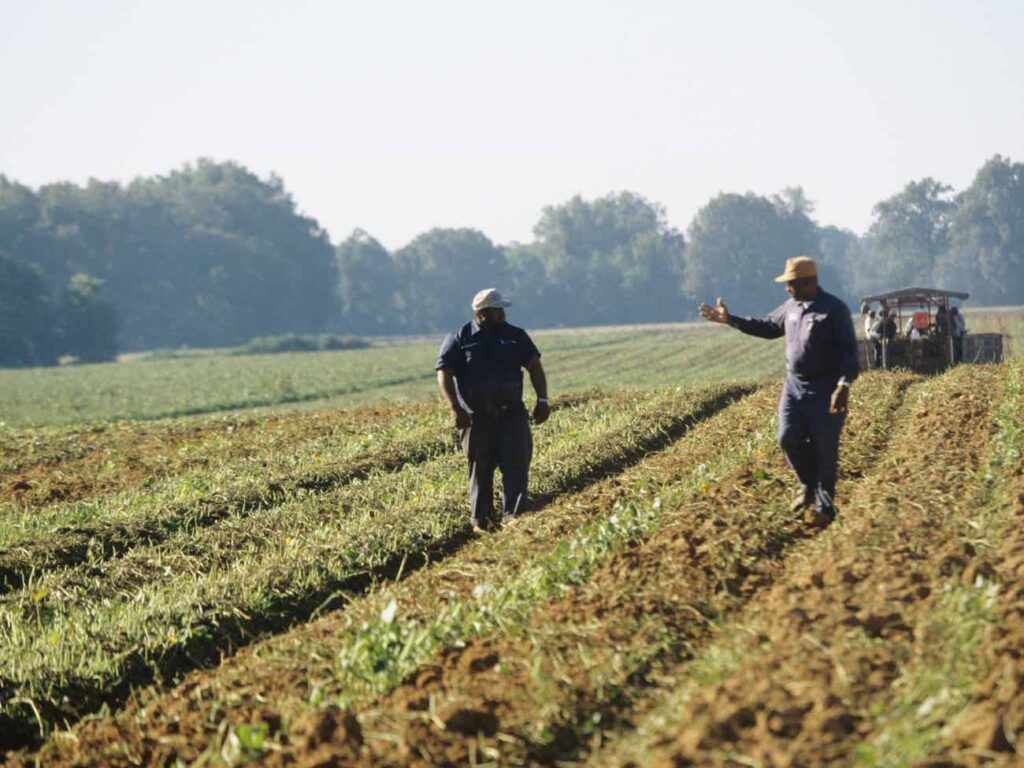
Five Black American farmworkers from the Mississippi Delta have filed a federal lawsuit against farmer Gregory Carr, alleging they were paid $10 per hour while white South African guest workers earned significantly more for the same work. Image: Getty images
Five Black American farmworkers have filed a federal lawsuit against a Mississippi farmer. The Mississippi farmworkers lawsuit alleges that Gregory Carr of Carr Farms discriminated against them by favouring white South African guest workers on H-2A visas. Furthermore, the Black workers allege they earned $10 per hour while the South African workers earned more for the same work. As a result, the case has drawn international attention at a sensitive moment in US-South Africa relations.
Mississippi Farmworkers Lawsuit: What the Five Workers Allege
The five plaintiffs are Michael Anthony Nash, Jimmy Shaw, Vinnie Cason, Grant Lewis and Charleston Taurvonta Harris. All five grew up in the Mississippi Delta and worked for Gregory Carr between 2018 and 2026. Furthermore, they allege Carr misused the federal H-2A visa programme. That programme only allows US farmers to hire foreign workers when no American workers are available.
Carr paid the Black American workers a flat rate of $10 per hour. However, the white South African H-2A workers received the legally required Adverse Effect Wage Rate. That rate ranged from $10.73 in 2018 to $14.83 in 2025. The plaintiffs allege Carr deliberately misclassified them as independent contractors. This classification helped him avoid paying them the same higher rate as the foreign workers. Furthermore, Carr allegedly offered the South African workers more hours and weekend work. He told local workers no work was available even as the guest workers stayed on. As a result, the Black workers lost both pay and opportunities.
Southern Migrant Legal Services and the Mississippi Center for Justice filed the lawsuit in federal court in Greenville. It seeks damages for unpaid wages, breach of contract and emotional distress. Furthermore, the action claims Carr violated the Migrant and Seasonal Agricultural Worker Protection Act and the Civil Rights Act of 1866.
Who Are the South African Workers
White South Africans have worked on H-2A guest worker visas in the US since the early 1990s. They first worked on the Great Plains, moving from farm to farm to cut crops. Over time, more young Afrikaans-speaking men settled in the Mississippi Delta. Furthermore, the Trump administration granted Afrikaner South Africans refugee status in 2025. That decision accelerated their presence in the region and added a political dimension to an already tense employment dispute.
Residents of Mound Bayou describe the shift to South African crews as deliberate displacement. Mound Bayou is a Mississippi town founded by formerly enslaved people to protect Black farmers from discrimination. Herman Johnson Jr., director of the Mound Bayou Museum of African American Culture and History, told The Clarion-Ledger he regularly sees the South African workers around town. “I see these guys when I go to Walmart. They usually wear short pants and speak Afrikaans to each other. It doesn’t make sense economically. A lot of things white supremacy does don’t make economic sense,” he said.
A Pattern the Courts Have Seen Before
This is the ninth such case filed by Southern Migrant Legal Services and the Mississippi Center for Justice. All eight previous cases settled out of court with significant wage recoveries for Black workers. Furthermore, some earlier cases involved South African workers who died on the same farms.
Eugene Nicholas, a 20-year-old South African farmworker, died in October 2022 at Bare Bones Farms in Itta Bena, Mississippi. He fell into a soya bean silo without a harness. His body took five hours to recover. Furthermore, in 2023 another young South African, Nantes Lennox from Springbok in the Northern Cape, died after suffocating in a grain bin at the same farm. Bare Bones Farms faced a $90,182 penalty for wilful safety violations. As a result, the Mississippi Delta has become a deeply contested space for South African workers, American workers and the law.
What the Lawyers Say About the Mississippi Farmworkers Lawsuit
Attorney Tessa Pulaski of Southern Migrant Legal Services was direct. “The H-2A programme allows American farmers to hire foreign labour when no US workers are available. It does not allow farmers to pay their American workforce less than the foreign workers and misclassify them,” Pulaski said. Furthermore, Kimberly Jones Merchant, President and CEO of the Mississippi Center for Justice, described the pattern clearly. “The intentional underpayment and misclassification of Black farmworkers in favour of white foreign labour not only violates federal law but has become increasingly common in the Mississippi Delta,” Merchant said.
Why This Story Matters to South Africa
The Mississippi farmworkers lawsuit arrives at a complicated moment. South Africa and the United States already disagree on multiple fronts. Trump’s tariffs, the Afrikaner refugee programme and foreign policy tensions have all strained the bilateral relationship. Furthermore, the image of white South African workers earning more than Black American workers in the Mississippi Delta carries enormous symbolic weight. That region defines American racial history. As a result, this federal lawsuit has the potential to become one of the most politically charged South Africa-related stories of 2026.
Editors Note All allegations are drawn from the federal lawsuit filed by Southern Migrant Legal Services and the Mississippi Center for Justice in Greenville, Mississippi and from publicly available court documents. Gregory Carr is presumed innocent until proven guilty in a court of law. All claims are unproven and will be tested in court. Mzansi Today Live will update this article as further information becomes available.