

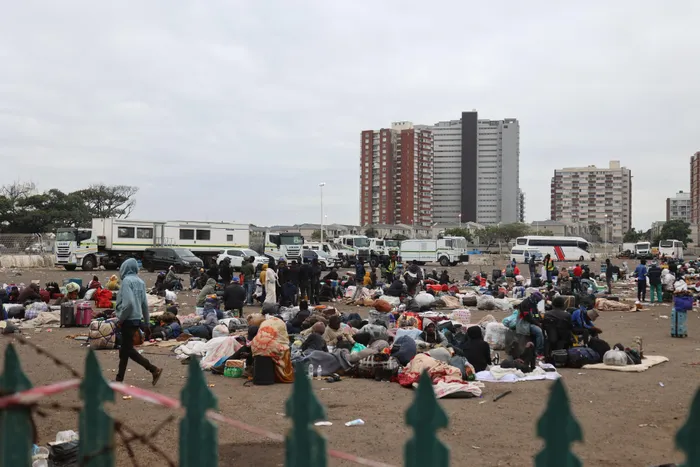
Malawian nationals at the Old Durban Drive-In repatriation site told journalist Nokwazi Qumbisa that their employers deliberately delayed paying their wages, knowing the workers were undocumented and had limited recourse. Image: Tumi Pakkies
Malawian nationals arriving late at South African repatriation sites say they were not hiding. They were waiting to be paid. The Malawian workers unpaid wages crisis has emerged as one of the most troubling untold stories of the repatriation saga. Furthermore, journalist Nokwazi Qumbisa spoke to Malawian nationals at the Old Durban Drive-In who revealed that their employers knew they were undocumented and deliberately used that vulnerability to underpay and delay their wages. As a result, many missed earlier repatriation transport while waiting for money that many employers have still not paid.
Malawian Workers Unpaid Wages: What Nokwazi Qumbisa Found at the Old Durban Drive-In
Qumbisa spoke to multiple Malawian nationals at the Old Durban Drive-In repatriation site. Their accounts were consistent and deeply troubling. Workers said they could not join earlier repatriation convoys because they were still waiting for payday. Furthermore, several confirmed that their employers knew they were undocumented or in the country illegally. As a result, those employers allegedly exploited that knowledge to pay below the legal minimum wage and delay final payments, knowing the workers had limited recourse.
The workers also alleged that the practice of hiring undocumented Malawian nationals at low wages was not accidental. Most employers deliberately sought out illegal foreign workers specifically because they could pay them less and treat them as expendable. Furthermore, because those workers feared drawing attention to their immigration status, they were unlikely to complain to the Department of Employment and Labour or the CCMA. As a result, the repatriation crisis has exposed a system of deliberate and systematic labour exploitation that appears to have operated openly for years.
More Than 400 Workers Still Waiting Outside
More than 400 Malawian nationals is currently camped outside a repatriation site. They allege their employers still owe them wages and they cannot leave without the money. Furthermore, the workers come from communities including KwaMamdegazi and Verlum. As a result, the problem stretches across multiple areas and involves multiple employers rather than being an isolated incident.
The Old Durban Drive-In officially closed as a repatriation site on Wednesday 1 July 2026 after processing more than 20,000 Malawian nationals. Musina in Limpopo now serves as the ongoing processing centre. The Malawians arriving at closed or closing sites were not late because they did not want to leave. They were late because they were waiting for wages that most of their employers have still not paid. Furthermore, many of them took on debt to travel to South Africa in the first place. Returning without their final wages would leave them with nothing, or worse, with debt they cannot repay. As a result, for many of these workers the decision to wait was not a choice. It was a financial necessity.
South African Law Protects All Workers Regardless of Status
This is a critical point that many workers themselves do not know. South African labour law protects all workers in South Africa, including undocumented foreign nationals. The Basic Conditions of Employment Act and the Labour Relations Act apply to everyone who performs work in South Africa regardless of nationality or documentation status. Furthermore, the National Minimum Wage Act entitles every worker to at least R30.23 per hour regardless of their documentation. As a result, an employer who withholds wages from a Malawian worker, documented or not, is breaking South African law.
What These Workers Can Do Even After Leaving South Africa
The most important thing for these workers to know is that leaving South Africa does not necessarily end their right to claim unpaid wages. There are steps they can take both before and after departure.
Before leaving, workers should try to collect evidence of their employment. This includes payslips, bank deposit records, WhatsApp messages confirming employment or wages, photos of their work location and the name, address and phone number of their employer. Furthermore, a written record of how many hours or days they worked and what they were promised is critical. As a result, even a basic written note or screenshot can support a wage claim later.
Workers still in South Africa can lodge a wage complaint at any Department of Employment and Labour office. The department can investigate wage theft, compel employers to pay outstanding wages and impose penalties on employers who fail to comply. Furthermore, this process does not require valid immigration documentation. As a result, even undocumented workers can use this route.
Workers can also refer an unpaid wages dispute to the Commission for Conciliation, Mediation and Arbitration, known as the CCMA. The CCMA resolves labour disputes quickly, without lawyers and at no cost to the worker. A CCMA order is legally enforceable against an employer. Furthermore, the CCMA does not require a worker to have valid immigration documentation to lodge a dispute. As a result, this is the fastest and most accessible route for recovering unpaid wages before departure.
For workers who have already left South Africa, the Malawian High Commission in Pretoria can receive and forward wage complaints on behalf of returned citizens. Furthermore, the Malawian government should formally document employer details from every returned worker who reports unpaid wages. Those records can be used to pursue claims through diplomatic channels and through South African courts even after the worker has returned to Malawi. As a result, departure is not the end of the road for these workers if the right records are kept.
Workers and their families can also contact organisations that assist migrant workers with labour rights claims. These include the South African Federation of Trade Unions, the Congress of South African Trade Unions and civil society organisations that specifically assist migrant workers. Furthermore, legal aid clinics attached to South African universities assist workers with wage claims at no cost. As a result, workers do not need money to access legal help.
Why Employers Target Undocumented Workers
The accounts Qumbisa collected at the Old Durban Drive-In confirm what researchers have long documented. Employers in certain sectors deliberately recruit undocumented workers because those workers are less likely to assert their legal rights. André Duvenhage, a research director at North-West University, told CNN that employers often perceive migrant workers as willing to work for lower wages and less likely to use labour protections available to them. Furthermore, the current immigration climate makes undocumented workers even more reluctant to draw attention to themselves by lodging complaints. As a result, some employers are using the repatriation crisis as cover to withhold wages, knowing that workers may leave the country before pursuing claims.
President Cyril Ramaphosa acknowledged in his national address on 7 June 2026 that undocumented migration distorts the labour market by enabling employers to exploit cheaper labour. He committed to prosecuting employers who do so. The government confirmed that enforcement operations have already resulted in arrests of employers who hired and exploited undocumented foreign nationals. As a result, the legal risk to exploitative employers is real, even if consistent enforcement remains a challenge.
What Should Happen Now
The Malawian government, the South African Department of Employment and Labour and civil society organisations need to act urgently. Repatriation transport at Musina and other active sites should not depart until workers who wish to lodge wage claims have been given access to a CCMA representative or a Department of Employment and Labour official. Furthermore, the Malawian High Commission should actively document employer details from every worker reporting unpaid wages so that claims can continue even after the worker has returned home. As a result, there is a practical and legal solution available if the political will exists to implement it before the last buses leave.
These workers came to South Africa to work. They worked. They deserve to be paid. The law is on their side. The question is whether anyone will help them use it.
Workers seeking to lodge wage claims can contact the Department of Employment and Labour. Workers can also contact the CCMA.
Editors Note The accounts in this article are based on interviews conducted by journalist Nokwazi Qumbisa with Malawian nationals at the Old Durban Drive-In repatriation site. The figure of more than 400 workers waiting outside a repatriation site is based on reports from the scene and has not been independently verified by official sources. The Old Durban Drive-In officially closed on Wednesday 1 July 2026 after processing more than 20,000 Malawian nationals. Musina in Limpopo now serves as the active processing centre. All information about South African labour law is accurate as at 2 July 2026.