

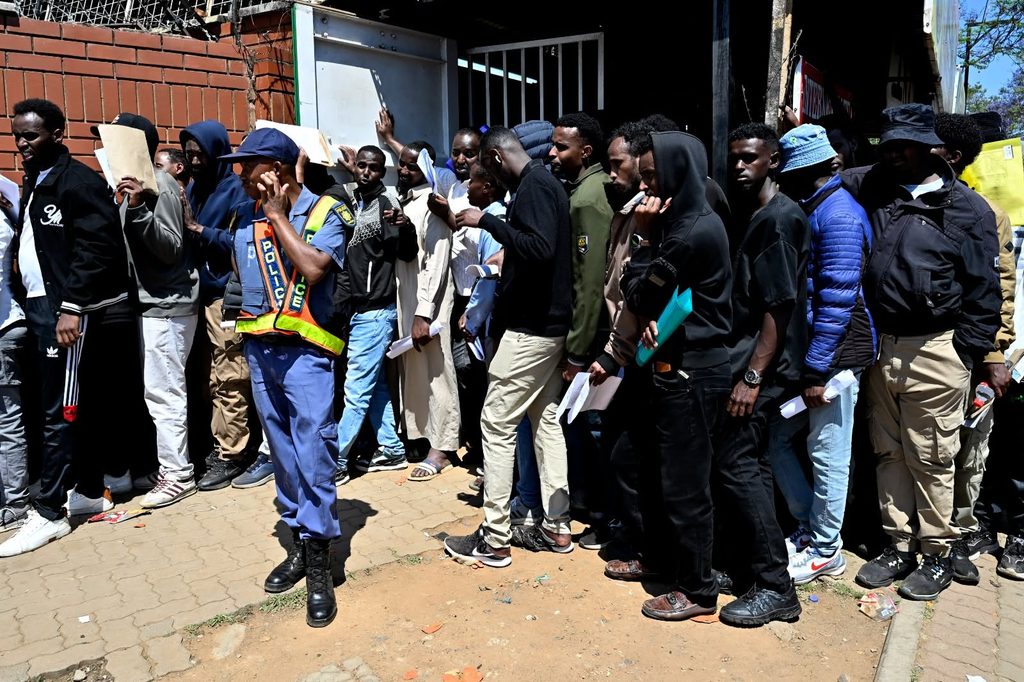
Government has launched a Myth of the Day campaign to explain what the Constitutional Court asylum ruling does and does not do. Image credit Itumeleng English
Government has launched a campaign to tackle asylum ruling myths, as anger and confusion continue over the Constitutional Court judgment on asylum seekers. Justice Minister Mmamoloko Kubayi, who chairs the inter ministerial committee on migration, shared a series of Myth of the Day graphics on Friday to set the record straight.
The campaign follows weeks of tension. Protests turned violent in Durban and Soweto, refugee offices became overwhelmed, and false claims spread rapidly on social media. Government now wants to explain, in plain language, what the ruling does and what it does not do.
The biggest asylum ruling myths
One of the myths government targeted is the idea that all foreign nationals are refugees. According to government, this is false. Foreign nationals in South Africa include visitors, workers, students, permanent residents, asylum seekers, refugees and undocumented migrants. Different laws apply to each group.
Government also took on claims that asylum seekers are undocumented. In fact, asylum seekers receive official documents while Home Affairs processes their applications.
Furthermore, government stressed that the ruling does not grant anyone automatic refugee status, permanent residence or citizenship. Every applicant must still go through the full refugee status determination process. Officials will assess each claim against strict criteria in South African and international law.
Government also dismissed claims that refugees will be able to vote. According to the committee, people with refugee status do not have the right to vote under South African law.
In addition, government rejected fears that asylum seekers will overwhelm Home Affairs services for citizens. It pointed out that the country has only five refugee reception offices, which operate separately from ordinary Home Affairs offices.
The Constitutional Court delivered its judgment in July, in a case brought by the Scalabrini Centre of Cape Town and Lawyers for Human Rights. The court struck down parts of the Refugees Act that blocked people from applying for asylum on technical grounds alone. These included entering the country illegally, not holding an asylum transit visa or missing the deadline to report to a refugee office.
In other words, officials can no longer turn people away simply because of how they entered the country. Instead, officials must consider each claim on its merits. However, the court did not change the requirements for qualifying as a refugee.
Government also made clear that deportations will continue. Officials will deport people who do not qualify for protection, or who abuse the asylum system, once the legal process is complete. Officials will also reject fraudulent and unfounded claims.
At the same time, government says the judgment reaffirmed an important principle. South Africa may not send people back to countries where they could face persecution, war or serious harm, before officials properly assess their claims.
The confusion began after Home Affairs issued a directive on 28 September. It told refugee offices to accept new asylum applications, including from people who entered the country illegally. Within days, crowds overwhelmed the offices, and protests turned violent. Home Affairs withdrew the directive on 9 October. Government now plans to launch an online registration system for asylum applications by 10 November.
Meanwhile, commentary across social media platforms remains heated. Many South Africans still fear the ruling will put pressure on jobs, schools, hospitals and safety, and some are calling for stronger border control. Others have welcomed government’s effort to fight false information and calm tensions.
Read more