

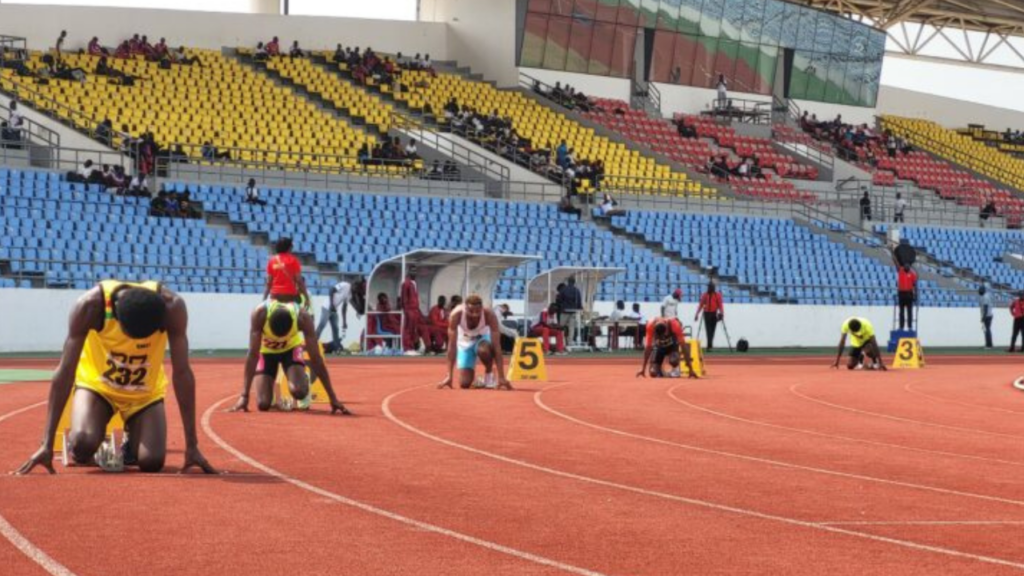
Athletes at Ghana’s African Athletics Championships in Accra were forced to go through video footage to determine the medallists of the men’s 100m final after timing systems failed. Image: Supplied
Ghana’s historic first hosting of the 24th Confederation of African Athletics Senior Championships in Accra has been marred by organisational failures so severe that a Ghanaian MP has called it a national embarrassment. The contrast with Botswana’s acclaimed hosting of the World Athletics Relays in Gaborone just two weeks earlier could not be more stark.
Less than two weeks after Botswana delivered what World Athletics President Sebastian Coe described as a benchmark event in African athletics hosting, the World Athletics Relays Gaborone 26 on 2 and 3 May 2026, Ghana has found itself at the centre of an embarrassing international conversation about sports organisation after the 24th Confederation of African Athletics Senior Championships descended into chaos on its opening days in Accra.
The event, being held at the University of Ghana Stadium in Legon from 12 to 17 May 2026, marks Ghana’s first time hosting the continental senior athletics championships. The milestone has been significantly overshadowed by a catalogue of organisational, logistical and welfare failures that have left athletes, officials and sports journalists deeply critical of the Local Organising Committee’s preparation.
Broken Poles and Contradictory Explanations
The most alarming incidents of the championships involved the breaking of multiple vaulting poles during competition. An Ivorian pole vaulter’s pole broke during their attempt. Athletes from South Africa and Benin also experienced pole failures. While no injuries were reported, the breakages caused significant disruption and raised immediate safety concerns.
Officials offered contradictory explanations. Some suggested the poles were athlete-owned equipment rather than gear provided by organisers. Others defended the equipment supplied for the event. The conflicting accounts left athletes and observers without a clear or satisfactory explanation and raised questions about whether adequate pre-competition equipment checks had been conducted at all.
No Starter’s Gun, Denied Food, No Toilet Paper, No Air Conditioning and No Timing Data
The equipment failures were far from the only problem. A starter’s gun was reportedly absent during track events, forcing officials to improvise starting procedures at a senior continental championship. Athletes reported being denied adequate food at the competition village, not merely poor quality meals but insufficient quantities that left competitors unable to meet the nutritional demands of high-level athletic competition. Toilet paper was reportedly unavailable in athlete facilities. Air conditioning was either absent or non-functional in accommodation areas, leaving athletes in uncomfortable conditions that fell well below the standard expected of a professionally managed championship.
Perhaps most extraordinary of all was the situation in the men’s 100m final. Without functioning timing equipment or adequate officiating technology, athletes and officials were forced to go through video footage frame by frame to determine the medallists of the marquee sprint event of the championships. At a senior continental championship, the highest level of African athletics competitors stood around watching replays to find out who had won their own race.
For accredited journalists the situation was equally challenging. Real-time timing data was not being provided, leaving reporters unable to accurately cover race outcomes. Athletes who had just finished competing were reportedly asking officials for their finishing times and receiving no response.
Ghanaian sports journalist Yaw Ofosu captured the frustration bluntly. “What is an athletic meet without the times the athletes finished? How are we as journalists supposed to tell the stories? How do we know how well they have done here in comparison to what they did in other meets? Athletes finish races and are asking for their times and it’s crickets,” Ofosu wrote on X.
The Botswana Comparison That Stings
The contrast being drawn repeatedly by athletes, officials and observers is with Botswana’s hosting of the World Athletics Relays in Gaborone just eleven days before Ghana’s championships began. The Gaborone event, the first World Athletics Relays ever held on African soil, was widely praised as a model of organisation, atmosphere and delivery.
Botswana delivered record-breaking performances, a passionate home crowd, smooth logistics and a professional standard of hosting that earned explicit praise from World Athletics President Sebastian Coe, who described Africa as having become a benchmark in athletics event delivery. South Africa won two silver medals at the Gaborone event. Letsile Tebogo helped power Botswana to one of the fastest relay performances in history. It was, by any measure, a resounding success for African sports hosting.
Ghana’s Accra championships, by contrast, has produced broken poles, denied food, no toilet paper, no air conditioning, cold showers, missing timing equipment and athletes watching video replays to find out who had won the 100m final. The two events took place within the same two-week window on the same continent. The contrast in preparation and delivery has not been lost on anyone watching.
It is worth noting that the Confederation of African Athletics has already awarded the next edition of the African Senior Athletics Championships to Botswana — the same nation that delivered the acclaimed World Relays just two weeks ago.
A National Embarrassment
Vincent Ekow Assafuah, ranking member of Ghana’s Parliamentary Select Committee on Youth and Sports, did not mince his words when he appeared on the Asaase Breakfast Show on Thursday 14 May 2026. “This is an international embarrassment. Something must be done urgently to salvage Ghana’s name,” Assafuah said, citing widespread organisational lapses despite what he described as significant budgetary provisions having been allocated for the event.
Assafuah also separately criticised Sports Minister Kofi Adams over what he described as unlawful government interference in the Ghana Swimming Association, warning that the minister’s conduct risked further tarnishing Ghana’s standing in international sports circles. World Aquatics has already written formally to the minister warning that government interference in the swimming association’s affairs could jeopardise Ghanaian athletes’ participation in international competitions including the Olympic Games.
The Local Organising Committee issued an apology after the opening day, with representative Veronica Commey acknowledging that excessive noise around the venue had created an uncomfortable environment for media and that operational challenges had affected the first day of competition. The apology was received without enthusiasm by those who had experienced the full range of problems at the venue.
South African Athletes Among Those Affected
South Africa’s contingent at the Accra championships has been directly affected by the organisational failures. A South African athlete was among those who experienced a pole vault equipment failure during competition. South Africa’s team at the event includes Bradley Nkoana, who won silver at the Paris 2024 Olympics as part of the men’s 4x100m relay team, and Prudence Sekgodiso, among others. South African Athletics had not issued a formal statement on the equipment failures at the time of publication.
The Championships Continue
Despite the controversy, the 24th Confederation of African Athletics Senior Championships continues in Accra through to 17 May 2026. World record holder Tobi Amusan of Nigeria is among the headline competitors. Organisers have been urged to urgently address the outstanding welfare, logistical and equipment concerns before the championships conclude.