

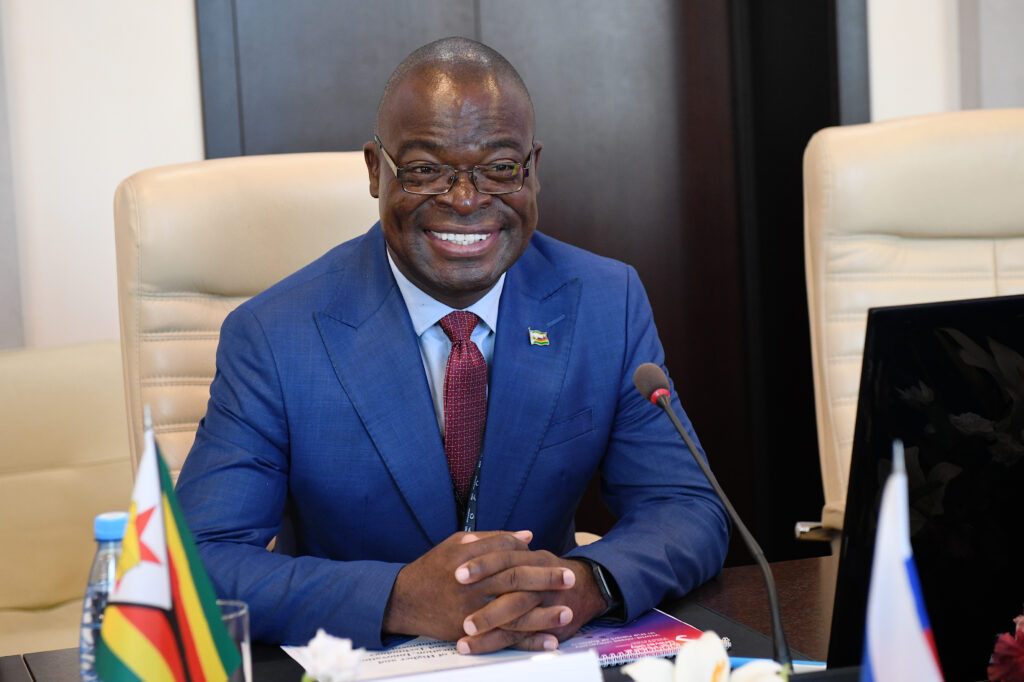
Zimbabwe’s Foreign Affairs Minister Dr Amon Murwira told SABC News there is no migration crisis, speaking on the sidelines of a SADC foreign ministers meeting hosted by DIRCO in South Africa. Image : Ural federal university
Zimbabwe’s Foreign Affairs Minister Dr Amon Murwira has denied that a migration crisis exists, speaking to SABC News on the sidelines of a SADC foreign ministers meeting hosted by DIRCO in South Africa. His comments come as multiple African governments including Ghana and Nigeria have taken publicly assertive positions over the situation facing their nationals in South Africa.
Zimbabwe’s Foreign Affairs Minister Dr Amon Murwira has stated that no migration crisis exists, making his position clear in an interview with SABC News journalist Khayelihle Khumalo on the sidelines of a Southern African Development Community foreign ministers meeting hosted by South Africa’s Department of International Relations and Cooperation. Murwira’s statement represents one of the most direct responses from any African government minister on a controversy that has dominated the continent’s diplomatic conversation in recent weeks.
What Murwira Said
Speaking to SABC News at the SADC foreign ministers gathering, Murwira stated that there is no migration crisis. His position effectively challenges the framing adopted by several other African governments and international commentators who have characterised the current situation in South Africa as requiring urgent intervention, evacuation flights and African Union attention.
The setting of his remarks is significant. A SADC foreign ministers meeting hosted by DIRCO is the kind of formal diplomatic platform where African governments would be expected to raise concerns about the safety of their nationals if they considered those concerns substantiated and urgent. Murwira’s choice to deny the existence of a crisis in that setting rather than amplify it is a notable diplomatic position.
Zimbabwe’s Position Stands Apart
Murwira’s statement stands in contrast to positions taken by several other African governments in recent weeks. Ghana’s Foreign Affairs Minister Samuel Okudzeto Ablakwa announced a government-funded evacuation flight for 300 Ghanaian nationals, citing safety concerns for African migrants in South Africa. When that flight departed OR Tambo International Airport on Thursday 21 May 2026, one person was on board, 22-year-old Sylvester Boakye from Pretoria, who arrived at the airport the previous evening and waited through the night with no government officials available to assist him.
Nigeria announced a voluntary repatriation programme for its citizens. Both Ghana and Nigeria formally raised the matter with the African Union. Multiple African countries issued travel advisories.
Zimbabwe, whose nationals make up one of the largest migrant communities in South Africa, has taken a different approach. Murwira did not call for evacuations. He did not raise the matter as a crisis at the SADC meeting. He told SABC News directly that there is no migration crisis.
Why Zimbabwe’s Position Carries Weight
Zimbabwe’s response is particularly noteworthy given the scale of its nationals’ presence in South Africa. No country has more of its citizens living and working in South Africa than Zimbabwe. No country’s nationals are more directly affected by the day-to-day realities of South Africa’s immigration debate. Zimbabwe has one of the longest and most complex migration relationships with South Africa on the continent, with its nationals arriving in significant numbers since the economic and political crisis of the late 1990s and early 2000s.
If any government had standing to declare a migration crisis, it was Zimbabwe. That its Foreign Affairs Minister chose instead to deny the existence of a crisis at a formal SADC diplomatic gathering on South African soil is a significant diplomatic signal.
The Broader Context
Murwira’s statement comes at a moment of heightened tension in South Africa’s immigration debate. Former President Thabo Mbeki has condemned rising anti-migrant sentiment. The African Union has been formally requested to place South Africa’s alleged xenophobia on its agenda. International media have characterised recent events in South Africa as a xenophobic crisis.
South Africa’s government has consistently rejected that characterisation, maintaining that recent protests were largely peaceful demonstrations calling for the enforcement of existing immigration and labour laws rather than attacks on foreign nationals. The South African Police Service confirmed it was working to identify and prosecute individuals responsible for any acts of violence against foreign nationals.
Denialism and Its Consequences
South Africa’s unemployment rate currently stands at 32.7 percent. Its public hospitals, schools, housing and municipal services are under documented strain in communities most affected by population pressures. Its spaza shop economy has been at the centre of sustained community conflict. These are conditions that community organisations, civic movements, protest groups and parliamentary committees have consistently linked, in part, to the consequences of undocumented migration and the failure to enforce existing immigration and labour legislation.
Commentary across social media and from community organisations reflects the view that the denial of a migration crisis by governments whose citizens are central to the immigration debate does not resolve the underlying tensions. South Africans online have argued that official denials from foreign governments, delivered at formal diplomatic platforms, reflect a pattern that has characterised the debate for years and that this pattern of denial has contributed to the accumulation of frustration that has now reached diplomatic and international dimensions.
Whether Murwira’s assessment reflects the genuine view of the Zimbabwean government, a diplomatic calculation at a SADC gathering, or a considered reading of conditions on the ground is not something that has been publicly clarified. What is clear is that his statement has added a new dimension to a debate that shows no signs of resolution in the near term.
Editors Note All information in this article is based on Dr Amon Murwira’s interview with SABC News journalist Khayelihle Khumalo at the SADC foreign ministers meeting hosted by DIRCO. The views expressed by members of the public referenced in this article are those of South Africans online and on the ground and do not represent the editorial position of Mzansi Today Live. Mzansi Today Live will update this article as further information becomes available.