

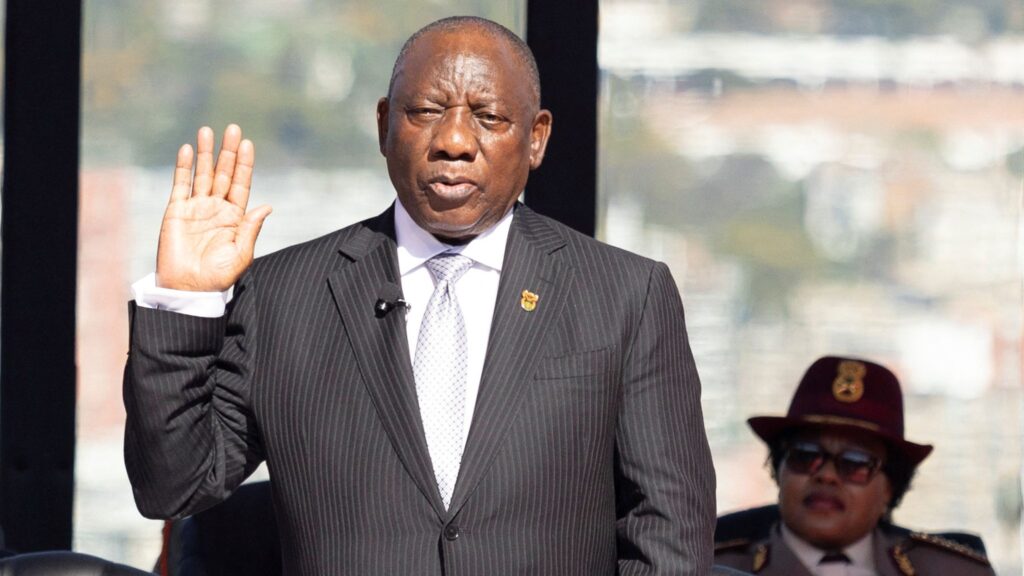
The Constitutional Court delivered its landmark Phala Phala judgment, ordering Parliament to begin an impeachment inquiry into President Cyril Ramaphosa. Photo: Reuters
In a landmark ruling delivered exactly 30 years after the adoption of South Africa’s Constitution, the Constitutional Court has found that Parliament acted unlawfully when it blocked an impeachment process against President Cyril Ramaphosa over the theft of foreign currency at his Limpopo game farm. The Section 89 panel report must now be referred to an impeachment committee.
The Constitutional Court has delivered one of the most consequential judgments in South Africa’s democratic history, ruling on Friday 8 May 2026 that Parliament acted unlawfully when it voted in December 2022 to dismiss the Section 89 Independent Panel report on the Phala Phala scandal. The ruling effectively restarts an impeachment process against President Cyril Ramaphosa that had been blocked for more than three years. The judgment was delivered exactly 30 years to the day after South Africa’s Constitution was adopted a date that has not been lost on legal analysts and political observers.
What the Court Ruled
Chief Justice Mandisa Maya, delivering the judgment at Constitutional Hill in Braamfontein, Johannesburg, declared parliamentary rule 129(i)(b) inconsistent with the Constitution and set aside the National Assembly vote of 13 December 2022 that had blocked the Phala Phala accountability process from advancing. The court found that the rule had effectively blocked an impeachment process without meaningful engagement on a motion during a parliamentary vote, which the chief justice said undermined the constitutional values of accountability and transparency.
The court ordered that the Section 89 Independent Panel report on the Phala Phala matter must be referred to an impeachment committee of the National Assembly. The National Assembly has also been ordered to amend rule 129 to bring it in line with the Constitution. The ruling came 521 days after arguments were heard in the matter in November 2024.
The case was brought by the Economic Freedom Fighters and the African Transformation Movement, who approached the apex court after Parliament declined to adopt the Section 89 panel report. The EFF had been vocal about the lengthy delay, with party leader Julius Malema writing to Chief Justice Maya in March 2026 demanding clarity on what he described as an unacceptable delay that risked eroding public confidence in the judiciary.
What Is the Phala Phala Scandal
The Phala Phala scandal centres on a 2020 incident at President Cyril Ramaphosa’s Phala Phala game farm in Limpopo, in which approximately $580,000 worth approximately R9.6 million at current exchange rates was allegedly stolen. The matter first became public in 2022 when former State Security Agency director-general Arthur Fraser laid criminal charges against Ramaphosa, alleging that the foreign currency had been concealed at the farm and that the theft was not reported through official police channels. Fraser alleged that Ramaphosa instead relied on private security operatives to investigate the incident.
An independent panel chaired by retired Chief Justice Sandile Ngcobo was established by Parliament to assess the allegations. The panel concluded that there was prima facie evidence suggesting Ramaphosa may have acted inconsistently with the Constitution, particularly in relation to transparency and legal compliance, and that he may have violated his oath of office. The panel’s finding significantly heightened political tensions and prompted calls from opposition parties for impeachment proceedings.
In December 2022, the ANC which at the time still held a parliamentary majority — used that majority to vote down the adoption of the panel’s report, effectively blocking the impeachment process. It is that vote that the Constitutional Court has now declared unlawful and set aside.
The Accountability Gap
Despite the independent panel’s findings, several state institutions had cleared Ramaphosa through parallel investigations. The National Prosecuting Authority declined to pursue criminal charges, stating that available evidence was insufficient to support a successful prosecution. The South African Revenue Service, the SA Reserve Bank and the Public Protector also reached conclusions that effectively narrowed the scope for criminal prosecution and accountability through those channels.
The Democratic Alliance, which had initially been outspoken in its criticism of Ramaphosa and had written to SARS and the FBI in connection with the undeclared foreign currency, shifted its position after entering into the Government of National Unity with the ANC following the 2024 national elections. The DA subsequently made clear it would not support moves to remove Ramaphosa from office.
However, a recent probe by the Independent Police Investigative Directorate recommended disciplinary action against two SAPS officers, including the former head of the Presidential Protection Service, Major General Wally Rhoode, in connection with the Phala Phala matter.
Ramaphosa Pledges Cooperation
Before the judgment was delivered on Friday morning, Ramaphosa told reporters that he would respect whatever the court decided. “Whatever the courts decide is what the court decides,” the president said. “I have no view on that.”
Following the ruling, the Presidency issued a statement confirming that Ramaphosa “respects the Constitutional Court’s judgment” and “reaffirms his commitment to the constitution, the independence of the judiciary and the rule of law.” The statement added that the president had consistently provided full assistance to enquiries into the matter and called on all South Africans to respect the ruling.
Political Reactions
EFF leader Julius Malema welcomed the ruling outside Constitutional Hill on Friday, characterising it as a vindication of the party’s years-long pursuit of accountability. “You cannot vote to protect criminality. You cannot vote to protect corruption because every vote must be accompanied by rationality,” Malema said. He argued that the ruling confirmed the ANC had abused its parliamentary majority to shield its leader from constitutional scrutiny.
Al Jama-ah leader and Deputy Minister of Social Development Ganief Hendricks indicated that Government of National Unity partners intended to stand by Ramaphosa regardless of the ruling. Hendricks suggested Ramaphosa might offer to step aside but that the ANC would not accept such an offer. The DA said it would comment after studying the full judgment. Rise Mzansi and the GOOD Party also indicated they would wait for the full judgment before responding.
What Happens Now
The Constitutional Court’s ruling does not remove Ramaphosa from office. What it does is direct Parliament to establish an impeachment committee to properly consider the Section 89 panel report. Chief Justice Maya noted that an impeachment inquiry of this nature could take many months to complete.
For an impeachment to succeed and Ramaphosa to be removed from office, a two-thirds majority vote in the National Assembly would be required under section 89 of the Constitution. Given the current composition of Parliament where the ANC and its GNU partners collectively hold a significant majority the prospect of such a vote succeeding remains a matter of considerable debate among political analysts.
What is beyond dispute is that the judgment has fundamentally altered the political landscape. A sitting president now faces a formal parliamentary impeachment inquiry for the first time in South Africa’s democratic history. The proceedings, their duration, and their ultimate outcome will be watched closely by South Africans and the international community alike.
Editors Note President Cyril Ramaphosa has not been charged with or convicted of any criminal offence in connection with the Phala Phala matter. The Constitutional Court’s ruling relates solely to Parliament’s procedural conduct in December 2022 and does not constitute a finding of guilt against the president. All persons are presumed innocent until proven guilty in a court of law. Mzansi Today Live will update this article as further information becomes available.